Skip to content Leviticus: A Call to Holiness Feb 26 · 14 min ...more
Support this leader Liking this video? Support this ministry.
Support this leader
Liking this video? Support this ministry.
Give
Support this leader Liking this video? Support this ministry.
93.9K followers
Family Research Council is serving in the kingdom of God by championing faith, family, & freedom in public policy and the culture from a biblical worldview.
93.9K followers
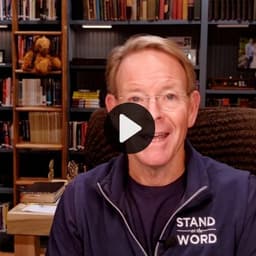
Introduction to the Book of Leviticus 0:11 Good morning. Welcome to Stand on the Word as we begin our fourth book on this 2 year journey through the Bible. Today we begin the book of Leviticus as we look at chapters 1 through 3,0:23 verse 1 of chapter 1. Now the Lord called to Moses and spoke to him from the tabernacle of meeting, saying. So the Hebrew title of the book in the Hebrew Bible comes from the very first0:35 verse, which we see frequently in the Old Testament, and he called. Now that phrase and God called appears 56 times in all 27 chapters of Leviticus,0:46 which actually kind of fits nicely with the New Testament term used for the church, ekklesia, the called out ones. Now the title that we have in our English Bible comes from the Greek Septuagint meaning0:58 and it means pertaining to the Levites. But that's really not descriptive of the book. The book is about much more than that. It could be it could be seen as kind of a continuation of1:10 the book of Exodus, the people called out of bondage who now have an identity, not as slaves, but as the people of God, a new nation. So Leviticus is a part of shaping that new nation by1:22 setting out how they were to approach God and to worship him. Now if you were to sum up the book of Leviticus in 1 sentence, it would be this. God who is holy has called his people to1:34 holiness. Moses is the author. The book was written in a relatively short period of time, a month and 20 days after the setting up of the the temple and the move from Mount1:46 Sinai as recorded in Numbers chapter 10 verse 11. Now it came to pass on the twentieth day of the second month in the second year that the cloud was taken up from above the tabernacle of the1:57 testimony. So it was written in a very short period of time. Exodus, focused on the details of of how to build the tabernacle and Leviticus is how to to use it, how, again, to2:09 worship God. It was the place that they were to meet God. The book is kind of the manual that accompanied the new tabernacle, giving instructions to the new nation on how to worship, which2:21 as we will see worship is all encompassing. It's not just about what you do 1 hour a week. It is about how we live our lives in holiness before a holy God. Now after2:33 you read these first 3 chapters you might be saying, Why are we reading this? Well first it is the Word of God. It's here for a reason. Again I've I'll quote this many times but I go to what2:45 Paul said in second Timothy chapter 3 verse 16.3:01 Paul was writing was writing about the Old Testament. So it's the word of God, but it's also a picture. As we get into this, you're gonna see it. It is a picture of the redemptive work of Jesus Christ.3:13 Everything is pointing to Jesus, and we see that. That's why the old testament is so important in laying the foundation for us to have a full understanding of the New Testament. Now3:25 some, are quick to dismiss Leviticus as a book of ancient guidance that has no application to us. It is a book of worship, how the children of Israel were to approach3:37 God and worship Him. It shows us the way to God. I see Leviticus as an answer to Moses' prayer that he prayed back in Exodus chapter 33 verse 13. He said3:49 this, Now therefore I pray, if I have found grace in your sight, show me now your way, that I may know you and that I may find grace in your sight and4:01 consider that this nation is your people. Moses asked God to show him his way. And here it is in Leviticus. Now to be very clear, we are not under the law. So So the system4:12 of sacrifices, rituals, and ceremonial law do not apply to us today under the new covenant. As Matthew Henry wrote, he wrote this, quote, The remaining record of these abrogated laws is4:24 of use to us for the strengthening of our faith in Jesus Christ as the lamb slain from the foundation of the world, and for the increase of our thankfulness to God, that by4:36 him we are freed from the yoke of the ceremonial law and live in the times of reformation. End quote. So the book of Leviticus helps us better understand4:48 the completed work of Jesus Christ on the cross, and it also contains spiritual principles. Okay? Those principles that can guide us and strengthen us5:00 in our walk with the Lord. Alright. The first 3 chapters, we find in the first 3 chapters we find 3 of the 5 offerings thatThe Voluntary Offerings Pointing to Christ 5:12 are described and discussed. Now all of which, all of these offerings, point to the Messiah. Look at what the author of Hebrews writes, Hebrews 9 11.5:25 But Christ came as high priest of the good things to come with the greater and more perfect tabernacle not made with hands, that is not of this creation, not with the5:37 blood of goats and calves but with his own blood, he entered the Most Holy Place once for all, having obtained eternal redemption. Once and for5:48 all. The atoning work of Jesus Christ is complete. Nothing can add to it. Nothing can take away from it. The sacrifices, again, of the Old Testament each provided a picture6:00 of what was to come in Jesus Christ, who would be that final sacrifice. Now all of these sacrifices can be a bit confusing, so I'm going to outline the sacrifices6:12 as we read about that we read about here in the first 3 chapters. Let's begin verse 1. Now the Lord called to Moses and spoke to him from the tabernacle of meeting, saying, speak to the children of Israel and say to6:24 them, when any 1 of you brings an offering to the Lord, you shall bring your offering of the livestock, of the herd, and of the flock. If his offering is a burnt offering of the herd, let6:36 him offer a male without blemish. That was important. He shall offer it of his own free will at the door of the Tabernacle of Meeting before the Lord. Then he shall put his6:48 hand on the head of the burnt offering and it will be accepted on his behalf to make atonement for him. Alright. Again there are 5 main types of sacrifices,7:00 3 of which were voluntary and 2 were mandatory. The 3 voluntary sacrifices were the burnt offering which we just read about. It was an expression, it was for atonement,7:12 total surrender to God, and worship of God. Now notice that the the burnt offering was totally consumed. Right? Everything was burned up except the hide, which the priest could have7:24 the hide. But notice that the hand of the 1 making the offering was placed on the head of the sacrifice. This was a transference of sin. The animal was taking on the sin of the7:36 person. Now the burnt offering could be a bull, it could be a bird or a ram. And as I mentioned, the priest could have the animal hide. Everything else was consumed by fire. Next, there was the grain offering.7:47 Let's go to chapter 2 verse 1. When anyone offers a grain offering to the Lord, his offering shall be a fine flour and he shall pour oil on it and put frankincense on7:59 it. He shall bring it to the to Aaron's sons, the priest, 1 of whom shall take it from his hand of a fine take from it his handful of fine flour and oil with all the frankincense.8:12 And the priest shall burn it as a memorial on the altar, an offering made by fire, a sweet aroma to the Lord. The rest of the grain offering shall be Aaron's and his sons. It8:23 is most holy it is most holy of the offerings of the Lord made by fire. The grain offering, which expressed thanksgiving to God for his provisions and8:35 blessings, this would include the first fruits offering. From this offering, the priest could keep a portion, but it had to be eaten within the court of the tabernacle by those who were sanctified.8:48 Alright. In chapter 3, moving pretty quick here, chapter 3 we have the third type of offering in these first 3 chapters. Verse 1, chapter 3, When his offering is a sacrifice of a peace offering, if he9:00 offers it of the herd, whether male or female, he shall offer it without blemish before the Lord. We don't give the Lord here's 1 of these principles. We don't give Him the leftovers. Alright?9:13 We see this over and over. God wants our best. Alright? And he shall lay his hand on the head of his offering and kill it at the door of the tabernacle of meeting. And Aaron's sons, the priest, shall9:25 sprinkle the blood all around the altar. Then he shall offer from the sacrifice of the peace offering, an offering made by fire to the Lord, the fat that covers the entrails, and all the fat that is on the9:36 entrails. The 2 kidneys and the fat that is on them by the flanks and the fatty lobe attached to the liver above the kidneys, he shall remove. And Aaron's son shall burn it on the altar9:49 of burnt sacrifice, which is on the wood that is on the fire as an offering made by fire, a sweet aroma to the Lord. The peace offering was a sacrifice of10:01 thanksgiving and fellowship, which was followed by a shared meal with family or friends. The high priest was given the breast of the animal, the officiating10:12 priest, the right foreleg. These were wave or heave offerings. They were waived over the altar during the ceremony. And then the the priest kept those. The the fat,10:24 the kidney, and the lobe and of the liver were burnt on the altar as an offering to God. The remainder was for making the offering10:36 to eat. So the people then would have this peace offering. It would be kind of a celebration. The peace offers included the vow of thanksgiving and the free will offering. Alright.10:48 Next time we're going to look at the the next 2 offerings. Now keep in mind, the Old Testament system of sacrifice was a temporary temporary11:00 appeasement for sins that were committed. The blood of animals could not redeem man. Alright? It could only make a temporary atonement or covering. It didn't take away the sin. It only covered it.11:12 Jesus Jesus redeemed us once and for all by his death on the cross. His blood removes the guilt of sin for those who11:24 accept Him and the sacrifice that was made by Him. Now as we continue, through Leviticus, it's going to come together, Okay? And you will see how the system of11:36 sacrifices is kind of like a jigsaw puzzle. Then the 1 missing piece that makes the picture come alive is Jesus, which, you know, from our vantage point in human11:47 history, we have the privilege to see it very clearly. I mean, we see how the old testament pointed to Jesus and how all of the pieces come together if if our eyes are11:59 open. And that's why we pray to the Holy Spirit to guide us on this journey and and help us to see the truth of God's word. Father, thank you for your word, and we we12:11 do thank you for the Holy Spirit, and we ask the Holy Spirit to open our eyes and our understanding to see how all of this points to Jesus. Lord, help us on this journey. Lord, we want to learn. We want12:23 to, Lord, we know that Your word, it gives us the best understanding of who You are. Our finite minds are are are it's impossible12:35 for us to grasp an infinite God. But you have con contained in in your word, Lord, an understanding for us of who you are and how we are to approach you.12:48 And and as Moses prayed, Show us your ways that we might walk in your grace. So we pray and ask all this in Jesus' name. Amen. Thanks for joining me this morning. And look,12:59 we're going to make it through Leviticus. And you're going to find that this is an exciting book. In fact, the book of Leviticus is probably 1 of the most significant books in the Bible. Probably not heard many sermons13:11 from it, but I think you're going to discover some transformational truths as we make our way through the book of Leviticus. Until next time, keep standing on the word.13:24 Today's study comes from the stand on the word bible reading plan, available for free at frc dot org slash bible. By following along in just a few minutes a day, you13:36 can read through the entire Bible in just 2 years. Learn more and request the free reading guide at frc dot org slash bible.In this video 0:00 Introduction to the Book of Leviticus5:07 The Voluntary Offerings Pointing to Christ
Up next Autoplay More from Tony Perkins Ron Johnson, Andrew Clyde, Blaise Misztal, Michele Bachmann, Gary Hamrick Tony Perkins
11/9/2026 Reflections on How the Midterms Will Shape the Future Congressional Agenda and Foreign Policy Tony Perkins
From Tekoa to Bethel: A Shepherd’s Warning of Judgment Tony Perkins
Mercy Triumphs Over Judgment: God’s Desire to Restore Tony Perkins
David Wurmser, Ryan Bangert, Jeanne Seaver, David Closson Tony Perkins
11/6/2026 America’s Future Foreign and Domestic Policies and Responding Biblically to Cultural Challenges Tony Perkins
Joel 1:14 — Consecrate a Fast: A Pastoral Call to Repentance Tony Perkins
Randy Fine, Chris Mitchell, Amanda Dixon, Igor Bandura, Casey Harper Tony Perkins
11/5/2026 How Will Democrats Govern With Growing Anti-Semitism in Their Party? Tony Perkins
Hands on the Bow: Prophetic Authority and National Repentance Tony Perkins
Eric Burlison, John Rogers, Jack Hibbs, Suzanne Bowdey, Casey Harper Tony Perkins
Comments No comments yet. Start the conversation.


Comments
Keep it kind. Comments are public.