Faith & Wisdom
Who Was Melchizedek?
Melchizedek in the Bible: the king of Salem who blessed Abram, what his name means, the different ways Christians read him and why Hebrews compares him to Jesus.

PRAY.COM
Published · 6 min read
Share this
Key takeaways
- Melchizedek is named twice in the Old Testament and nine times in the New, all of them in Hebrews.
- The name joins two Hebrew words, melek (king) and tsedeq (righteousness).
- Hebrews was written to believers who knew the law of Moses well.
- AI-assisted from Pray.com episode transcripts, then reviewed and approved by Ryan Beck.

New prayers every day, read aloud so you can pray along.
- Morning
- Pray Daily
- Midday
- Pray Midday
- Night
- Pray Nightly
Free, and millions of people already pray with Pray.com.
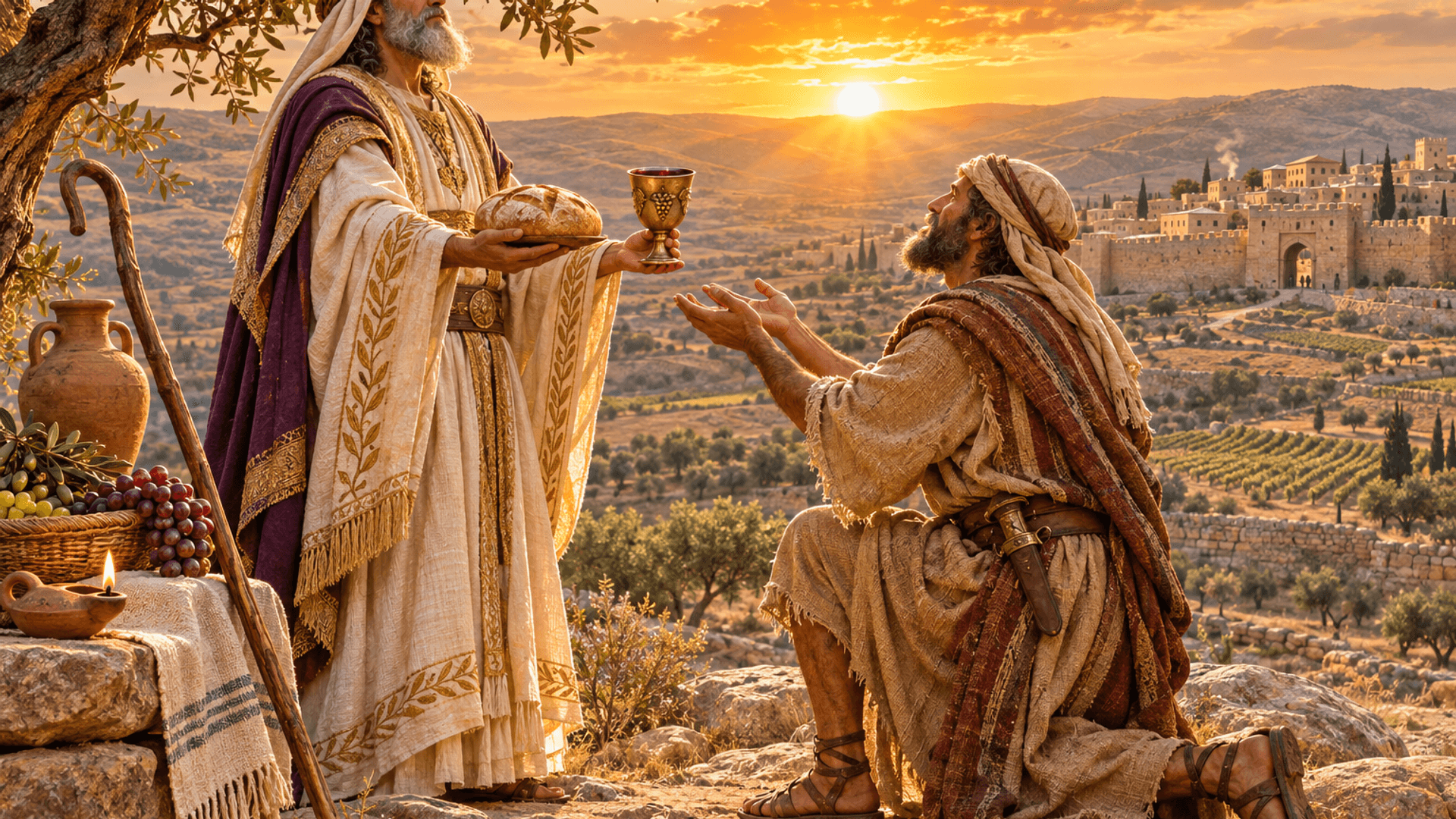
Melchizedek was the king of Salem and "priest of God Most High" who met Abram with bread and wine, blessed him and received a tenth of everything Abram had recovered in battle (Genesis 14:18-20). He appears in only three verses of Genesis and one verse of the Psalms. The letter to the Hebrews then spends most of a chapter on him, because it presents Jesus as "a high priest forever after the order of Melchizedek." Who was Melchizedek, and why does the Bible connect a little-known Canaanite king to Jesus? This guide walks through what the text says and how Christians have read it.
Pastor Jeff Schreve of First Baptist Church Texarkana and From His Heart Ministries teaches through the passage in "The Mystery of Melchizedek," part of his Hebrews series Jesus Above All on Pray.com, which you can listen to above. His short answer is a helpful place to start: "He was a real person who serves as a picture of Jesus." All Scripture below is from the World English Bible (WEB), which pray.com hosts.
Where does Melchizedek appear in the Bible?
Melchizedek is named twice in the Old Testament and nine times in the New, all of them in Hebrews. The first appearance comes right after Abram rescues his nephew Lot from a coalition of four kings who had raided Sodom. On Abram's way home, two kings come out to meet him, the king of Sodom and a king no one has heard of before:
Advertisement
"Melchizedek king of Salem brought out bread and wine. He was priest of God Most High. He blessed him, and said, 'Blessed be Abram of God Most High, possessor of heaven and earth. Blessed be God Most High, who has delivered your enemies into your hand.' Abram gave him a tenth of all."Genesis 14:18-20, WEB
The Hebrew title translated "God Most High" is El Elyon. Melchizedek worshiped the same God as Abram, centuries before Moses and the law. About a thousand years later David wrote a royal psalm that Jesus himself quoted (Matthew 22:44), and in the middle of it God makes a promise to David's Lord: "The LORD has sworn, and will not change his mind: 'You are a priest forever in the order of Melchizedek'" (Psalm 110:4, WEB). That single verse is the reason Hebrews returns to him again and again.
What does the name Melchizedek mean?
The name joins two Hebrew words, melek (king) and tsedeq (righteousness). Hebrews spells out both his name and his city: he is "first, by interpretation, 'king of righteousness', and then also 'king of Salem', which means 'king of peace'" (Hebrews 7:2, WEB). Salem is related to the word shalom. Most interpreters identify it with the city later called Jerusalem, and Psalm 76:2 sets Salem beside Zion: "His tabernacle is also in Salem. His dwelling place in Zion" (Psalm 76:2, WEB).
Schreve notes how well the two meanings fit Jesus, since in Melchizedek "you have righteousness in his name and you have peace in his kingdom." Paul makes the same pairing: "Being therefore justified by faith, we have peace with God through our Lord Jesus Christ" (Romans 5:1, WEB).
Was Melchizedek a pre-incarnate appearance of Jesus?
This is the question most readers ask, and it comes from one verse. Hebrews describes him as "without father, without mother, without genealogy, having neither beginning of days nor end of life, but made like the Son of God" (Hebrews 7:3, WEB). Christians have read that verse in three main ways.
Some early Christian writers, and some modern teachers, have suggested Melchizedek was a pre-incarnate appearance of Christ, like the mysterious visitor who spoke with Abraham in Genesis 18. A few have proposed that he was an angel. Most Catholic, Orthodox and Protestant interpreters hold that he was a real, historical king and priest whose story Genesis tells in a way that makes him a picture of Christ. Genesis gives no parents, no birth and no death for him, so on the page of Scripture he simply appears and remains a priest.
Hebrews draws its point from that silence.
Advertisement
Schreve holds the third view and argues it from the wording itself. "He's not the son of God, he is made like the son of God," he says, which is the language of a likeness pointing to someone greater. He also rules out the angel view by citing Hebrews 5:1, which says every high priest is "taken from among men" (Hebrews 5:1, WEB). Readers who hold a different view are in good company, and the main teaching of Hebrews stands either way: Melchizedek points to Jesus.
Why does Hebrews compare Jesus to Melchizedek?
Hebrews was written to believers who knew the law of Moses well. Under that law every priest had to come from the tribe of Levi and every high priest from the family of Aaron. Jesus was from the tribe of Judah, so how could he be a priest at all? Psalm 110:4 answers the question, because it names a different and older priesthood. Hebrews says Jesus entered God's presence for us, "having become a high priest forever after the order of Melchizedek" (Hebrews 6:20, WEB).
- Pray with us todayToday's prayer
The writer then argues that this priesthood is greater than Aaron's. Abraham, the father of the whole nation, paid a tithe to Melchizedek and received his blessing, "But without any dispute the lesser is blessed by the greater" (Hebrews 7:7, WEB). Since Levi was Abraham's descendant, the writer says Levi in a sense paid tithes through him. Schreve summarizes the argument this way: "Jesus has a greater priesthood than Aaron, because he's greater than even Abraham, and he remains a priest forever."
There is a second link. In Israel the offices of king and priest were kept apart, and 2 Chronicles 26 records how King Uzziah was struck with leprosy when he tried to burn incense in the temple. Melchizedek held both offices at once. "Jesus is both priest and king, pictured in Melchizedek, who was both priest and king," Schreve says.
What does Melchizedek mean for Christians today?
The point of the comparison is personal. The Levitical priests died and had to be replaced, and they offered sacrifices again and again. Jesus never stops serving:
"But he, because he lives forever, has his priesthood unchangeable. Therefore he is also able to save to the uttermost those who draw near to God through him, seeing that he lives forever to make intercession for them."Hebrews 7:24-25, WEB
Hebrews adds that Jesus offered a sacrifice "once for all, when he offered up himself" (Hebrews 7:27, WEB). A believer doesn't need a human go-between to approach God, because Jesus is that priest, and he understands us: "Let's therefore draw near with boldness to the throne of grace, that we may receive mercy and may find grace for help in time of need" (Hebrews 4:16, WEB).
Advertisement
Many Christians also notice the bread and wine Melchizedek brought out to Abram. Early church writers saw them as a foreshadowing of the Lord's Supper, and the Catholic Mass still names "the offering of your high priest Melchizedek" in its oldest Eucharistic prayer, the Roman Canon. Protestant readers tend to focus on his priesthood more than the meal. Abram's tenth is also sometimes cited in teaching on tithing, since it came hundreds of years before the law required one.
A prayer to Jesus our high priest
Lord Jesus, you are the king of righteousness and the king of peace. Thank you for being my high priest forever, for offering yourself once for all and for praying for me even now. When I feel far from God, remind me that I can come to the throne of grace with confidence because of you. Bless me as Abram was blessed, and make me grateful and generous in return. Amen.
More to read and hear on Pray.com
- The Mystery of Melchizedek | Jesus Above All with Jeff Schreve
- Names of God and Their Meanings
- Passover in the Bible: From Exodus to the Last Supper
- Prayer for Communion
AI-assisted from Pray.com episode transcripts, then reviewed and approved by Ryan Beck.
Advertisement
Quick answers
- Where does Melchizedek appear in the Bible?
- Melchizedek is named twice in the Old Testament and nine times in the New, all of them in Hebrews. The first appearance comes right after Abram rescues his nephew Lot from a coalition of four kings who had raided Sodom.
- What does the name Melchizedek mean?
- The name joins two Hebrew words, melek (king) and tsedeq (righteousness). Hebrews spells out both his name and his city: he is "first, by interpretation, 'king of righteousness', and then also 'king of Salem', which means 'king of peace'" (Hebrews 7:2, WEB). Salem is related to the word shalom.
- Was Melchizedek a pre-incarnate appearance of Jesus?
- This is the question most readers ask, and it comes from one verse. Hebrews describes him as "without father, without mother, without genealogy, having neither beginning of days nor end of life, but made like the Son of God" (Hebrews 7:3, WEB). Christians have read that verse in three main ways.
- Why does Hebrews compare Jesus to Melchizedek?
- Hebrews was written to believers who knew the law of Moses well. Under that law every priest had to come from the tribe of Levi and every high priest from the family of Aaron. Jesus was from the tribe of Judah, so how could he be a priest at all?
- What does Melchizedek mean for Christians today?
- The point of the comparison is personal. The Levitical priests died and had to be replaced, and they offered sacrifices again and again. Jesus never stops serving: "But he, because he lives forever, has his priesthood unchangeable.
- Pray with us todayToday's prayer
Hear the Bible read aloud and follow series from pastors like Jack Graham.
Create a free accountFree to use. Going ad-free is optional.
Keep reading
 God Is My Refuge and Strength: Psalm 46 and Finding Security in GodFaith & Wisdom · 6 min read
 Passover in the Bible: From Exodus to the Last SupperFaith & Wisdom · 7 min read
 Who Was Barabbas?Faith & Wisdom · 6 min read
- Who Was Mary Magdalene?Faith & Wisdom · 6 min read
- Maundy Thursday: Meaning and a PrayerFaith & Wisdom · 7 min read
- Psalm 23 Meaning, Line by LineFaith & Wisdom · 8 min read
- Romans 8:28 Meaning: "All Things Work Together for Good"Faith & Wisdom · 6 min read
- Eternal Security: What the Bible Says About "Once Saved, Always Saved"Faith & Wisdom · 10 min read
- Life Hacks From Proverbs: 12 Pieces of Old Wisdom That Still WorkFaith & Wisdom · 6 min read
- Daniel Fast Food List and Rules, With Daily ScripturesFaith & Wisdom · 7 min read