Faith & Wisdom
Maundy Thursday: Meaning and a Prayer
What happened on the night before Jesus died, why the day is called Maundy Thursday, how churches mark it and a prayer for Holy Thursday.

PRAY.COM
Published · 7 min read
Share this
Key takeaways
- The word "Maundy" comes from the opening of an old Latin chant sung during the foot washing, Mandatum novum do vobis, "A new commandment I give to you.
- Four things happened that evening, and each one is still part of how churches keep the day.
- Jesus explained it himself once he had sat down again.
- All Christians who mark the day remember the same events, and practice differs from church to church.
- If your church doesn't hold a service, or you can't get there, you can still mark the evening.
New prayers every day, read aloud so you can pray along.
- Morning
- Pray Daily
- Midday
- Pray Midday
- Night
- Pray Nightly
Free, and millions of people already pray with Pray.com.
Maundy Thursday is the Thursday before Easter, when Christians remember the night Jesus washed his disciples' feet, shared the Last Supper and gave them a new commandment to love one another. The Maundy Thursday meaning is packed into its name, which comes from the Latin word mandatum, "commandment." It is also called Holy Thursday, and in 2027 it falls on March 25 for most Western churches (Orthodox churches keep Holy Thursday on April 29, 2027, because their Easter date is calculated differently). This guide walks through what happened that night, why the day matters, how Catholic and Protestant churches keep it, and ends with a prayer you can use.
Pray.com's Bedtime Bible: Jesus series retells the evening in "The Last Supper," which you can listen to above. It is a dramatized retelling that adds detail to the Gospel accounts, and its narrator sums up the mood of the meal well: "This night was set aside for gratitude, contemplation, and worship." All Scripture below is from the World English Bible (WEB), which pray.com hosts.
What does Maundy Thursday mean?
The word "Maundy" comes from the opening of an old Latin chant sung during the foot washing, Mandatum novum do vobis, "A new commandment I give to you." Those words come from John's account of the supper:
Advertisement
"A new commandment I give to you, that you love one another. Just as I have loved you, you also love one another. By this everyone will know that you are my disciples, if you have love for one another."John 13:34-35, WEB
So the day is named after a command, and the command is love of a very specific kind. Jesus says "just as I have loved you," and in the hours that followed he showed what that meant by kneeling at his friends' feet and then walking to the cross. Paul's summary of the same night is the oldest written account we have, and it begins with a time stamp: "the Lord Jesus on the night in which he was betrayed took bread" (1 Corinthians 11:23, WEB).
What happened on the first Maundy Thursday?
Four things happened that evening, and each one is still part of how churches keep the day.
First, Jesus ate the Passover with his disciples. Luke records that he sent Peter and John ahead, saying, "Go and prepare the Passover for us, that we may eat" (Luke 22:8, WEB), and at the table he said, "I have earnestly desired to eat this Passover with you before I suffer" (Luke 22:15, WEB). Passover remembered the night God spared Israel in Egypt, when the blood of a lamb on the doorposts meant "I will pass over you" (Exodus 12:13, WEB). Christians have long read the Last Supper against that background. Paul later wrote, "Christ, our Passover, has been sacrificed in our place" (1 Corinthians 5:7, WEB). The Gospels differ a little on the timing (Matthew, Mark and Luke present the supper as the Passover meal, while John's account places the crucifixion as the Passover lambs were being prepared), and scholars have offered several ways to fit the accounts together.
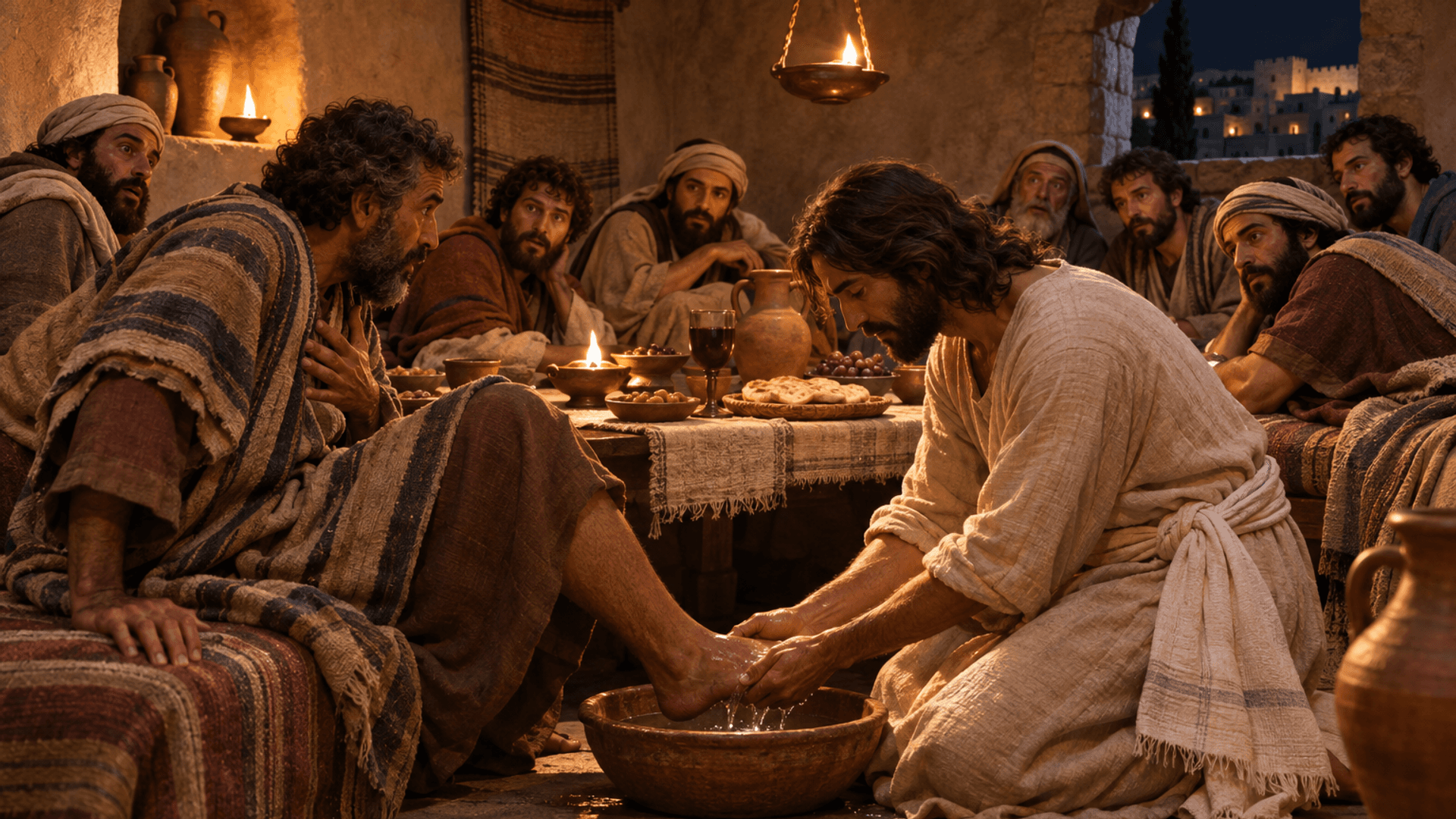
Second, Jesus washed their feet. John says he "laid aside his outer garments" and "poured water into the basin, and began to wash the disciples' feet and to wipe them with the towel that was wrapped around him" (John 13:4-5, WEB). Foot washing was a servant's job, and Peter protested, "You will never wash my feet!" Jesus answered, "If I don't wash you, you have no part with me" (John 13:8, WEB). He washed Judas's feet too, even though he knew what Judas planned. The Pray.com retelling puts it in one line: "There was no partiality in Jesus."
Third, Jesus gave the bread and the cup a new meaning. "This is my body which is given for you. Do this in memory of me," he said, and over the cup, "This cup is the new covenant in my blood, which is poured out for you" (Luke 22:19-20, WEB). Every celebration of Communion, the Eucharist or the Lord's Supper, goes back to this moment.
Fourth, the night turned dark. Judas left the table to betray him, and John adds a short, heavy line: "It was night" (John 13:30, WEB). After singing a hymn, Jesus went to the garden of Gethsemane and prayed, "My Father, if it is possible, let this cup pass away from me; nevertheless, not what I desire, but what you desire" (Matthew 26:39, WEB). He was arrested there later that night.
Advertisement
Why did Jesus wash the disciples' feet?
Jesus explained it himself once he had sat down again. "If I then, the Lord and the Teacher, have washed your feet, you also ought to wash one another's feet. For I have given you an example, that you should also do as I have done to you" (John 13:14-15, WEB). The foot washing is a picture of the whole mission of Jesus, who "came not to be served but to serve, and to give his life as a ransom for many" (Mark 10:45, WEB). Paul describes the same movement when he says Christ "emptied himself, taking the form of a servant" and "humbled himself, becoming obedient to the point of death, yes, the death of the cross" (Philippians 2:7-8, WEB).
- Pray with us todayToday's prayer
There is a second layer in Peter's exchange with Jesus. Being washed by Jesus comes before washing anyone else. Peter first had to let Jesus serve him, which for a proud fisherman may have been the harder lesson.
How do Catholic and Protestant churches keep Maundy Thursday?
All Christians who mark the day remember the same events, and practice differs from church to church.
In the Catholic Church, Holy Thursday begins the Easter Triduum, the three days that run from Thursday evening through Easter Sunday. The main service is the evening Mass of the Lord's Supper. After the homily the priest may wash the feet of members of the congregation. At the end of Mass the consecrated hosts are carried in procession to a side altar, often called the altar of repose, and many parishes keep watch there in prayer late into the night, recalling Jesus' words in Gethsemane: "Watch and pray, that you don't enter into temptation" (Matthew 26:41, WEB). The main altar is then stripped bare. Many dioceses also hold a Chrism Mass that week, where the bishop blesses the oils used in baptism, confirmation and anointing of the sick.
Protestant practice varies more. Lutheran, Anglican, Episcopal and Methodist churches commonly hold an evening Communion service, often with confession, and many include foot washing or the stripping of the altar. Some Presbyterian and other Reformed churches hold a Communion or Tenebrae service, in which candles are put out one by one as the Passion story is read. A few traditions, such as the Church of the Brethren, many Mennonite churches and Free Will Baptists, practice foot washing as an ordinance alongside the Lord's Supper. Many Baptist, nondenominational and other evangelical churches don't hold a separate Thursday service and focus on Good Friday and Easter instead.
Churches also understand the Lord's Supper itself differently. Catholic teaching holds that the bread and wine become the body and blood of Christ, and Orthodox Christians likewise speak of a real change. Lutherans teach that Christ's body and blood are truly present in the bread and wine. Reformed churches teach that Christ is truly present by the Spirit and received by faith, and many Baptists and evangelicals see the meal mainly as a memorial and proclamation. Each of these traditions takes its stand on Jesus' words "This is my body" and Paul's line, "as often as you eat this bread and drink this cup, you proclaim the Lord's death until he comes" (1 Corinthians 11:26, WEB).
Advertisement
The narrator in "The Last Supper" describes how far the meal would reach: "Hundreds, then thousands, then millions of people would gather around the world to eat bread and drink wine in remembrance of Jesus' body being broken and blood being shed for the remission of sins."
How can you keep Maundy Thursday at home?
If your church doesn't hold a service, or you can't get there, you can still mark the evening. Read John 13 aloud at dinner, from the towel and basin through the new commandment. Pick one specific act of service for someone in your house or neighborhood, something small and a little humbling, and do it that week. You could also spend some quiet time in prayer late in the evening, the way many Christians "watch" with Jesus on this night, using his own prayer from Gethsemane, "not my will, but yours, be done" (Luke 22:42, WEB).
The story also has a warning tucked into it. Judas sat at the same table and had his feet washed by the same hands. The Pray.com retelling has a sober line about the choice he made that night: "A purposeful sin always requires a willing ignorance." Maundy Thursday is a good night to ask God to show you anything you have been choosing not to see.
A Maundy Thursday prayer
Lord Jesus, on the night you were betrayed you took a towel and knelt at your friends' feet. Wash me first, and teach me to serve the people you have put next to me, including the ones who are hard to love. Thank you for your body given and your blood poured out for me. When I come to your table, help me remember you with a grateful heart. Give me the courage to pray "not my will, but yours," and keep me close to you through the dark hours until Easter morning. Amen.
More to read and hear on Pray.com
- The Last Supper | Bedtime Bible: Jesus
- Prayer for Communion
- Good Friday Meaning and Bible Verses
- What Happened at the Cross of Jesus
AI-assisted from Pray.com episode transcripts, then reviewed and approved by Ryan Beck.
Advertisement
Quick answers
- What does Maundy Thursday mean?
- The word "Maundy" comes from the opening of an old Latin chant sung during the foot washing, Mandatum novum do vobis, "A new commandment I give to you." Those words come from John's account of the supper: "A new commandment I give to you, that you love one another. Just as I have loved you, you also love one another.
- What happened on the first Maundy Thursday?
- Four things happened that evening, and each one is still part of how churches keep the day. First, Jesus ate the Passover with his disciples.
- Why did Jesus wash the disciples' feet?
- Jesus explained it himself once he had sat down again. "If I then, the Lord and the Teacher, have washed your feet, you also ought to wash one another's feet. For I have given you an example, that you should also do as I have done to you" (John 13:14-15, WEB).
- How do Catholic and Protestant churches keep Maundy Thursday?
- All Christians who mark the day remember the same events, and practice differs from church to church. In the Catholic Church, Holy Thursday begins the Easter Triduum, the three days that run from Thursday evening through Easter Sunday. The main service is the evening Mass of the Lord's Supper.
- How can you keep Maundy Thursday at home?
- If your church doesn't hold a service, or you can't get there, you can still mark the evening. Read John 13 aloud at dinner, from the towel and basin through the new commandment. Pick one specific act of service for someone in your house or neighborhood, something small and a little humbling, and do it that week.
- Pray with us todayToday's prayer
Hear the Bible read aloud and follow series from pastors like Jack Graham.
Create a free accountFree to use. Going ad-free is optional.
Keep reading
 Who Was Barabbas?Faith & Wisdom · 6 min read
 Who Was Mary Magdalene?Faith & Wisdom · 6 min read
 Psalm 23 Meaning, Line by LineFaith & Wisdom · 8 min read
- Romans 8:28 Meaning: "All Things Work Together for Good"Faith & Wisdom · 6 min read
- Eternal Security: What the Bible Says About "Once Saved, Always Saved"Faith & Wisdom · 10 min read
- Life Hacks From Proverbs: 12 Pieces of Old Wisdom That Still WorkFaith & Wisdom · 6 min read
- Daniel Fast Food List and Rules, With Daily ScripturesFaith & Wisdom · 7 min read
- Bible in a Year Reading Plan for 2027Faith & Wisdom · 6 min read
- Philippians 4:6-7 Meaning: "Do Not Be Anxious About Anything"Faith & Wisdom · 7 min read
- Identity in Christ: Bible Verses on Your Security in Who God Says You AreFaith & Wisdom · 9 min read