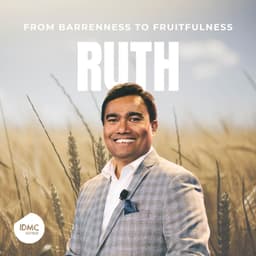
Skip to content Trusting God With Your Future | Ruth Part 2 | Rev Paul Jeyachandran May 29 · 44 min ...more
316K followers
Rev. Paul Jeyachandran leads the Intentional Disciple Making Church (IDMC) Movement, which is all about calling churches back to its disciplemaking roots. Visit us at idmcmovement.com
316K followers
0:01 Shall we give the Lord a clap offering church? Hallelujah. What a joy and a privilege for us to study the word of God together. Today, we are continuing in our sermon series on the book of Ruth.0:13 Today is part 2. I'm trusting that this message and this series will be a blessing to you. I'm titling today's sermon, trusting God with your future. We're gonna0:25 examine Ruth chapter 1 verse 6 to verse 22. Praise God. Let's look to the Lord in prayer. Heavenly father, we come before your throne room of grace. We acknowledge your0:37 sovereignty over our lives, Lord. And father God, in every season of our lives, we are convinced that you are working in our lives, that you are a Lord who is sovereign, who is0:48 good, who is wise, who is in control, and who will bring his purposes come to pass in our lives. So even as we worship you with this song, I pray that you continue to1:00 minister to our hearts and prepare us for the word today and let the holy spirit be our teacher. In Jesus' name. And people of God said, amen and amen. Would you sing the song with me?1:12 I don't need to understand. I just need to hold his hands. I1:24 don't ever need to ask the reason why. For I know he'll1:36 make a way through the night and through the day. I don't need to understand.1:49 I just need to hold his hands. Hallelujah.1:57 In every season of our lives, we can trust him. Can I give you a principle to take down? When you cannot trace his hand,2:09
2:21 today. Today in our sermon series on the book of Ruth, we are examining chapter 1 verse 6 to verse 22. I'm titling today's sermon, Trusting God with Your
2:33 Future. In our first message, we dealt with the subject of trusting God in your famine, and we examined this key question, how to avoid making
2:45 Moabic decisions. Today, in part 2, I want to talk about trusting God with your future and examine this 1 key question, how to survive the in between
2:56 season. In other words, you have left where you are, and you are on the way to where you need to be, but the in between season, you are neither in Egypt nor
3:08 in the Promised Land, but you are in the wilderness. How do you survive? How do you thrive in that season? Ruth chapter 1 and verse 6 says to us,
3:20 Then Naomi arose with her daughters in law to return from the country of Moab, for she had heard in the fields of Moab that the Lord had visited his people and
3:32 given them food. Verse 7 says, So she set out from the place where she was with her 2 daughters in law, and they went on the way to return to the land of Judah. In
3:44 our previous message, we examined that Elimelech, the father, the husband of Naomi and father of 2 boys, he took his family and relocated to
3:55 Moab. And we examined that it was a Moabic decision because it was a decision made out of circumstances rather than a call of God, rather than a compass that navigates
4:07 us towards the will of God. Listen carefully. In Ruth chapter 1 and verse 6, now we see the return of Naomi. We know the sad story that both Elimelech and his 2 sons
4:19 died, leaving behind 3 tombstones and 3 widows. Now, these 3 widows are now making a journey from Moab towards Bethlehem,
4:31 towards the land of Judah. What caused it? The Bible says, For she heard in the fields of Moab. What did Naomi hear? That the Lord had visited his
4:42 people and given them food. I want you to think about this. The writer is very particular here. He doesn't say that the famine has ended. He doesn't say that the earth has
4:54 started to produce fruit. He doesn't say that rain has come and the fields are now blossoming. He didn't say any of that. He says, the Lord had visited his people and given them food.
5:06 In other words, no matter what dark situations we go into, the reality is God has prepared for his people a way out. In other words, in every circumstances, there is
5:18 a providence of God. God has provided. And that is the theology we need to embrace. But here, as we see them approaching the border of Moab, You
5:30 know, they have come all the way. They have walked from their home all the way to the city gate now, and then there is a big decision, big dialogue between Naomi and the 2 daughters in law that we want to
5:42 meditate today. I want you to think about this. You know, this is a narrative passage. So whenever you're studying the narrative passage, I want you to use your sanctified imagination. And there are 4
5:54 lenses we use to see this passage. What is the lens? Number 1, the lens is a narrative tone. In other words, how things are being said, in what tone it's it's being
6:06 conveyed. Secondly, the narrative tension. In other words, there is a sub there is an element of, suspense that is being built up in the story, and I want you to see the tension. There is
6:18 a struggle. I want you to see that. The thirdly, there is a narrative twist. In other words, there is a surprise element in the story. In other words, whenever you see a
6:29 narrative, the narrative what makes the story gripping and exciting is the narrative twist. And lastly, every narrative has a theological purpose. In other words, you have to see the
6:41 theology. Narrative theology. In other words, every narrative passage has a theological purpose. So pay attention to what God is revealing about himself. So when you see this text,
6:53 these texts can be divided into 3 movie scenes. Scene number 1, the pain of hopelessness. In other words, from verse 8 to verse 13, it is the scene of hopelessness. It's the pain of
7:05 hopelessness. The second scene is the power of commitment. From verse 14 to verse 18, you see how Naomi and Ruth, they dialogue, but Ruth is committed to the cause, committed to her
7:16 mother-in-law. So there's the power of commitment. The scene 3, you can see the providence of God from verse 19 to verse 22. But even as you look at this as a movie scene, I want you to put
7:28 on your thinking cap and examine how you can apply this in our life today. And I want to examine this question, how to survive the in between season. There are
7:40 3 things I think this text teaches us. Number 1, watch your decisions in seasons of distress. From verse 6 to verse 13, we have a beautiful
7:52 narrative where Naomi is explaining to her daughters in law why they should not follow her. But I want you to see the progression of how the writer portrays
8:04 this. In verse 6, says, Naomi first heard. What did she hear? The Lord had visited his people and have given them food. In other words, she hears about the goodness of God,
8:17 the glory of God, the kindness of God, the covenantal love of God, and as a result, she wants to return back to Judah. And that's how she sets on a
8:29 journey with her 2 daughter in laws towards Bethlehem, towards the land of Judah. The Bible says in verse 7, they went on the way to return. That's a word for
8:40 repentance. In other words, a change of heart. In other words, here is a woman who had lost her husband and her 2 sons, and there is a lot of depressing things happening in her
8:51 life, but suddenly a ray of hope comes in. See, this highlights that hope is so important for us to survive the in between season. The Bible says in
9:03 Proverbs chapter 13 and verse 12, hope deferred makes the heart sick. In other words, when someone is going through disappointments of life, they're going through
9:15 disillusionment, You know, they have there are things that are happening in their life that continuously steal their joy and their hope from their life. What happens? It makes their heart sick. But the Bible
9:27 says a desire fulfilled is a tree of life. See, this is why hope is so important while you are in this in between season. So what do you need to do? You gotta surround yourself
9:39 with people of hope. You gotta come into the come into the house of God and surround yourself with people who can speak hope into your life. Read the word of God that brings hope into your life. Hear the word of
9:51 God that brings hope into your life. Hallelujah. You know, the experiment was done by Duke University. They took some rats from the wharf, and then they experimented with
10:02 this. They took 1 batch of rats and they put them into the water. And these rats, they struggled for 17 minutes and then they all died. So the
10:14 next experiment they did is they took another batch of rats and they put it into the water, and this time, around 12 minutes, they would take the rats out, dry them, and then
10:26 feed them food, and then they put them back again into the water. This time the rats survived 36 hours. Now, what was the difference between the first batch and the
10:38 second batch? The first batch didn't know what was happening, and they gave up hope, and they died. 17 minutes. The second batch, however, had hope. In other words, they knew that someone
10:50 will come and pick them up, someone will dry them and feed them food, so they survived longer. That's why hope matters. But in this situation, the writer begins
11:02 to explain to us, even though there is a hope within her heart, she still has certain disappointments that she's wrestling with. Look at this. The first thing that the writer actually helps you
11:14 understand between verse 8 to verse 10 is this, that good intentions may not lead to godly decisions. Look at the intention of Naomi. She said,
11:26 but Naomi said to her 2 daughters in law, go return each of you to your mother's house. She didn't say father's house. Why? Because she's saying rather than following the
11:37 mother-in-law, go back to your mother's house. May the Lord deal kindly with you as you have dealt kindly with the dead and with me. I love that word
11:48 kindly. Why? Because that word kindly is the Hebrew word, chesed. That word chesed means covenantal love. In other words, a loving kindness. And the Bible says
12:00 that Ruth and Otpa, the 2 daughters in law, showed their mother-in-law that kindness, and so the mother-in-law prays for the daughter-in-law. May the Lord show you that same
12:12 kindness. And then in verse 9, that the Lord grant you that you may find rest, each of you, in the house of your husband. Then she kissed them, they lifted up their voices and wept. Why
12:24 did she say, the Lord grant you grace to go find rest in your husband's house? In other words, she wants these 2 daughter in laws, the 2 young widows, to go back and to marry and to have
12:36 children and carry on with their life. Why? Because in those days, being a widow means being a destitute. That means they have no rights, they have nothing, they can't, the
12:47 inheritance is not with them, it only is transferred to the male, and if there's no male in the household, the women will suffer injustice. And so she's she's wishing
12:59 for them, I'm praying for you that the Lord will deal kindly with you. Not only that, that the Lord will grant you grace so that you will find rest in a husband's home. I want you to think about this. Every
13:11 marriage should be a place of rest for both the husband and the wife. When it's a place of rest, there will be shalom in every aspect. Isn't it? So beautiful here. And the Bible says in
13:23 verse 10, they said to her, no, we will return with you to your people. See, when I look look at this passage, as I said to you, good intentions may not lead
13:35 to godly decisions. The reason is, Naomi here has good intentions. She doesn't want the 2 women to suffer with her. She knows that when she if they follow her
13:47 into into Judah and in Bethlehem, they may not be welcome because they are Moabites. So she's sending them back and she's wishing them well. But can I humbly say this?
13:59 She's not just sending them back to their home, back to their people, she's also sending them back to their gods, their false gods that they worship. And as a result, this good
14:11 intention may not lead to a godly decision. So that's what we need to observe in our own life. In the in between period, you may have good intention to try something, but can I humbly say this, it may not
14:22 necessarily lead you to a godly decision? So that's why don't take matters into your own hands. The second thing the writer wants to highlight is great logic may not lead to godly decisions. Look at this
14:34 in verse 11. From verse 11 to verse 13, you have 1 of the best arguments that Naomi, she's presenting a flawless argument, she's presenting her case
14:46 point by point in a logical format, and she's saying, I have thought through this girls, you cannot come with me. Look at what she says, But Naomi said, turn back, my
14:58 daughters. Why will you go with me? Have I yet sons in my womb that they may become your husbands? Turn back, my daughters. Go your way, for I'm too old to have a husband. If I should
15:10 say, I have hope, even if I should have a husband this night and should bear sons, would you therefore wait till they were grown? Would you therefore refrain from marrying? No, my daughters, for it is
15:21 exceedingly bitter to me for your sake that the hand of the Lord has gone out against me. Look at her arguments. She has great logic here,
15:33 but even though she has great logic, that great logic is not leading her towards a godly decision. Pay attention. Number 1, she says, can I have more sons? No. Do I even have a prospect of a
15:45 husband? Obviously not. Hypothetically, humor be a bit, if I'm married tonight, that's a miracle number 1. If she gets married tonight, and then she had sons tonight, that's a miracle number 2,
15:57 would Orpah and Ruth wait for them to grow up, for them to get married? And the answer is no. With all her great logic, she's convincing, trying to convince her daughters in
16:09 law not to follow her. But the last thing she said, the fourth thing she said is, The Lord's hand has gone out against me. You know, only 3 times in the Bible, other than this passage,
16:21 you find the phrase, The Lord's hand has gone out against them. And in the context of that, it's always speaking about God's hand going against God's enemy.
16:33 That means Naomi, this situation, is thinking, God has turned his back towards me. God has put me away. I'm his enemy now because he's dealing with me in a
16:45 harsh reality. First he sent famine, then he sent me widowhood, then he took all my sons away, and now, look at now, my life is so filled with hopelessness. That's what she is
16:57 struggling now. So the key question we're examining in this text is, how do we survive the in between season? Number 1, watch your decisions in seasons of distress. In other
17:09 words, good intentions may not lead to godly decisions. Great logic may not lead to godly decisions. So watch your decisions in seasons of distress. Number 2, reveal your devotion with
17:20 steadfast determination. From verse 14 to verse 18, it is a beautiful passage. It reveals the power of commitment. And here is the dialogue. The Bible says
17:32 in verse 14, Then they lifted up their voice and wept again. I'm sure if this was made into a movie, there'll be a lot of people crying, a lot of Kleenexes being passed around
17:44 in the movie theater. Why? Because this is a tear jerking situation. The mother-in-law and the 2 daughters in law, they want to go be together, but the Naomi is so
17:55 adamant, you all should leave. And so they start crying. And then the Bible says, Orpah kissed her mother-in-law, but Ruth clung to her. You know, here is a play on word. Orpah
18:07 actually means, in Hebrew, the back of her neck. And true to her name, she showed the back of her neck to the mother-in-law and walked away after kissing her. Ruth, on the other
18:19 hand, the Bible says, clung to her, true to her name. Ruth means friendship, a compassionate friend. And that's what she is. She clung. And I know this language
18:30 being clung is actually the language of Genesis chapter 2 and verse 24. The Bible says, therefore a man shall leave his father and his mother and hold fast to his wife that they shall become
18:42 1 flesh. And that's exactly what the Bible says here Ruth did. It's almost like she's making a covenantal relationship with her mother-in-law. And then,
18:54 the Bible says, in verse 15, Naomi says to her, See, your sister-in-law has gone back to her people and to her gods. Return after your sister-in-law. In other words, when you go back
19:06 to your people, you're going back to your reality and worship of false gods. But here the Bible says in verse 16, Ruth presents 1 of the most beautiful
19:17 poem, a beautiful song in that sense of her heart's cry and her devotion, not only to Naomi, but to her people and ultimately to her
19:29 God. Look at this. Ruth said, do not urge me to leave you or to return from following you, For where you go, I will go, and where you lodge, I will lodge. Your people shall be my
19:41 people and your God, my God. Where you die, I will die, and there will I be buried. May the Lord do so to me and more also, if anything but death parts me from you.
19:53 And then verse 18 the Bible says, and when Naomi saw that she was determined to go with her, she said no more. I love that word, she was determined.
20:05 I want you to think about this. How do you survive the in between season? You've got to show, you've got to reveal your devotion. How do you review your devotion? You review
20:17 your devotion with steadfast determination. And that devotion can be seen in what we do. That's the first thing I want you to examine. In verse 14, it says, Ruth clung to her.
20:29 In other words, Ruth determined. In verse 18, it says, Ruth was determined to go with her. In other words, here's a commitment being made, and
20:41 this commitment is far greater than even a husband and wife, a marriage commitment. I want you to listen to me. This is between a mother-in-law and a daughter-in-law. But the Bible says that Ruth clung to
20:53 her. Ruth made a steadfast determination. I believe it is not only for Naomi that she's committing to. She doesn't want to go back to her people and to her
21:04 gods because she has now fallen in love with Naomi's God. Even though she sees the pain in Naomi's life, she knows about the God of Naomi, And she's wanting
21:16 to lay hold of God. And that is what you can see here. It's beautiful. But can I humbly say this? When Ruth is making this decision to follow Naomi, it is going to
21:28 cost her everything. See, when she goes back to her own home, to her mother's house, she has a prospect of getting married again. She has a prospect of loving people and and
21:40 surrounding her loving friends surrounding her, loving family surrounding her, and nurturing her. But when she comes into Judah, Judah had been tutored and trained and there is a commandment of God not to
21:51 receive Moabites. Not only that, they are not welcome into the house of God, even up to the tenth generation. Look at that. In Deuteronomy chapter 23
22:03 and verse 3, the Bible says this. In Deuteronomy chapter 23 and verse 3, no Ammonite or Moabite may enter the assembly of the Lord, even to the tenth generation. None of them may enter
22:15 the assembly of the Lord forever. In other words, there is no hope. But you know what? Naomi says to Ruth, go back. But Ruth says, no,
22:27 I believe this God of yours is a God of compassion. Even though Ruth knows that she will not be accepted in Judah, yet she's determined to show her commitment.
22:39 Can I humbly say this? This commitment comes with a price tag. Story was told of David Livingston. 1 day he received a letter from the missionary society in London, and
22:51 the missionary society had written to him to say, Have you found a good road leading to you so that we can send a group of men who are ready to come and join you on this mission?
23:03 David Livingston wrote back to them and said, I don't want those young men if those young men will only come to me if I have a good road leading to me. I want those young men to come even if there
23:15 was no road at all. I want you to listen to me carefully. No road at all, you will still come. Now what is that? That's a commitment. That's a commitment. That means that's a dedication. That's a
23:27 devotion. That's exactly what Ruth was saying. I'm committed to you. I'm committed to your God. I may not have a future, but I trust in this God who holds
23:38 my future. I want you to listen to me carefully. Secondly, devotion is seen in what we say. In verse 16 and verse 17, what a beautiful poem this is. You
23:50 know, if this was a movie, especially if this was a Bollywood movie, right here, these 2 verses will not be just something that Ruth will say to Naomi, but I think Ruth will
24:02 actually sing this to Naomi. Imagine this, Entreat me not to leave you, not to return from following you.
24:14 For where you go, will go, and where you lodge, I will lodge. Your people shall be my people
24:26 and your God,
24:29 my God. Where you die, I will die and there will I be buried. May the Lord do so to
24:40 me and more also for only death can part you from me.
24:50 I want you to listen to
24:53 me carefully. What happened there? Devotion is seen in what you say. From this beautiful poem, this beautiful narrative, you can see how Ruth
25:05 is committed. And she's not only committed to Naomi, but she's committed to the God of Naomi. Look at what she says there. She says that in verse 16, your God
25:16 will be my God. In other words, she's saying, your Elohim, that's the word, your Creator God is my Creator God. That's what the Jews believe, that He's the Creator
25:28 God. And she says, your God, my God. And then she goes on to claim the covenantal relationship. She says, may the Lord do so to me, more also if anything but death parts
25:40 me from you. In other words, may the Lord. Now she's calling on Yahweh, the covenantal relationship. In other words, deep down in Ruth's heart, she has already started to
25:52 trust in the God of Judah. She's already trusting in Yahweh. That's why she says, I I will hold on to him. You know, what a beautiful
26:04 passage to reveal to us that devotion is seen in not only what we do, but devotion is also seen in what we confess or what we say.
26:16 In 19 92, there was an article explaining the practices of ancient Greece. Now, in the political system in ancient Greece, politicians can
26:27 come and ask for a law to be passed. Now, there were people who were bringing some very stupid, unreasonable laws. So this is the practice they had in ancient
26:39 Greece. When a politician wants to introduce a law, they put him on a platform and they put a noose around his neck. Now, then he presents
26:51 the idea or the law. If the people like that idea, like the law, then the news will be removed and the law will be passed. But if
27:03 the people did not agree with that law, it is a stupid law, it's unreasonable, then instead of the news being removed, the platform will be removed. In other words, these politicians have to
27:15 learn that what they say, they have to be 100 percent convicted and convinced, and they have to be committed to it. That's commitment. Now here Ruth
27:26 not only showed it with her action, but the action actually revealed what was in her heart. And the Bible says she has no relationship, meaning there is no covenant between
27:38 Moab and God of Judah. But yet this woman, a Moabites, she lays hold of his covenantal kindness. And the Bible says, she now
27:50 believed in this God. Can I humbly say this? Romans chapter 10 and verse 13 says, for everyone who calls on the name of the Lord will be saved. This is quoting from Joel chapter 2 and verse
28:01 32. And it shall come to pass that everyone who calls on the name of the Lord shall be saved. In other words, it doesn't matter whether they are Jew or Gentile, whether they are Moabites or
28:13 Ammonites, as long as within their heart they cry out to God and they call upon the name of the Lord, they will be saved, the Bible says. So how do we survive in the
28:25 in between season? Number 1, watch your decisions in seasons of distress. Number 2, review your devotion with steadfast determination. And number 3, guard your disposition
28:37 against sullen despair. In other words, guard your disposition. Don't allow the circumstances to corrupt your inner life. Verse 19 to verse
28:49 22 reveals to us what happened when both these women came into the town of Bethlehem. The Bible says, so the 2 of them went on until they came to Bethlehem. And when they came to Bethlehem, the
29:00 whole town was stirred because of them. And the women said, is this Naomi? She said to them, do not call me Naomi, call me Mara, for the Almighty has dealt very bitterly with me. I went away full,
29:12 and the Lord has brought me back empty. Why call me Naomi when the Lord has testified against me and the Almighty has brought calamity upon me? So Naomi returned, and Ruth the Moabite, her
29:24 daughter-in-law, with her, who returned from the country of Moab, and they came to Bethlehem at the beginning of barley harvest. 2 things I want you to pay attention here. How do you
29:35 survive the in between season? How do you survive is you've got to guard your disposition from sullen despair. How do you do that?
29:47 Do not forget who is for you. Verse 19 to verse 22, the women in Bethlehem could see Naomi. It has been 10 years since she was
29:59 gone, but in that 10 years, Naomi has aged a lot. They couldn't identify her. See, means pleasant and beautiful and delightful, but
30:11 there is no delight, there's no pleasantness. Life has thrown so much affliction at her and she has allowed her inner life to be corrupted and now her countenance is showing it. So people couldn't
30:23 recognize her. Is this Naomi? They said. And verse 20 said, she said to them, do not call me Naomi, call me Mara. What does Mara means? Don't call me delightful and pleasant,
30:35 call me bitter. In other words, life has now become bitter. And then, she reveals something about God. Even though she
30:46 understands who God is, she fails to understand how God works. Look at this. She says, for the Almighty has dealt very bitterly with me.
30:58 She says, God is almighty. What is almighty? It's El Shaddai. El Shaddai means that He is powerful. He is all knowing. He's all powerful.
31:11 In other words, this God who is all powerful, all knowing, He has dealt very bitterly with me. She thinks that God is against her, that God is punishing
31:23 her. Can I humbly say this? Then in verse 21 she says, I went away full and the Lord has brought me back empty. Why call me Naomi when the Lord has testified against me and the Almighty has
31:35 brought calamity upon me? She again blames God for bringing calamity into her life. Can I humbly say this? I want you to listen to me carefully. It was
31:47 not God who was against her. It was them in their Moabic decision, thinking carnally, thinking physically, choosing to think about short
31:59 term gains rather than long term benefits. They walked away from the place of promise. They went to another place. But now she turns back and she blames God.
32:11 Isn't that what happens in people's lives, sadly? But they forget that even in their wanderings, even in their wilderness experience, God is still
32:22 sovereign. God is still good. God is still wise. God is still in control, and God is still bringing his purposes come to pass. In other words, do not forget that God is for
32:34 you. You know, there are a couple of verses I want to highlight. In Ecclesiastes chapter 7 and verse 14, the Bible says, in the day of prosperity be joyful. In the day of adversity consider
32:46 God has made the 1 as well as the other so that man may not find out anything that will be after him. In other words, it is God who made the day of prosperity and the day of adversity.
32:58 That is why he says, if God has made both, in both these circumstances, you should look to Him. In prosperity, be grateful to Him. In adversity, reflect upon
33:10 what He is doing. What is God accomplishing in my life? Listen carefully, because He is behind both. In Lamentations chapter 3 and verse 37 and 38, Who has spoken? And it
33:22 came to pass unless the Lord has commanded it. Is it not from the mouth of the Most High that good and bad come? In other words, this is a theology that God ultimately is sovereign over every
33:33 aspect of our lives. It is He who has permitted certain things in our life. Isaiah chapter 45 and verse 7, I form light and create darkness. I make well-being and create
33:45 calamity. I'm the Lord who does all these things. In other words, God says, I'm the 1 behind all that is happening. See, sometimes we as human beings, we make mistakes, we
33:57 go through painful seasons because they are self inflicted wounds, they are self inflicted necessary journeys, but humbly, can I humbly say this, God is still sovereign over all of
34:09 that? He still brings about his purposes through that. In Romans chapter 8 and verse 28, and we know that for those who love God, all things work together for good of those who love God and are called according to His
34:21 purpose. In other words, God makes all these things come together for our good. So even if God brings you through a season of wilderness, He permits it in your life and He brings you
34:33 into wilderness. Know this, in the wilderness, He's still with you and He's still for you. The Bible says in Psalm chapter 30 and verse 5, For His anger is but for a moment and
34:45 his favor is for a lifetime. I love that. His favor is for a lifetime. And then the Bible says, weeping may endure for the night, but joy comes in the morning. In other
34:56 words, even though God may take you into the wilderness, that necessary journey, if God brings you into the wilderness, know this, He is with you in the wilderness. He
35:08 is for you even in that wilderness. He is not there to destroy you, but He is there to define you and to develop you and to release you into your destiny. Listen carefully.
35:21 The second thing that the passage highlights for us is, do not forget who is with you. In Ruth chapter 1 and verse 19, the Bible says, the 2 of them went on until
35:32 they came to Bethlehem. Naomi and Ruth both came to Bethlehem, but Naomi confesses, I went away full, I came back
35:44 empty. In other words, she didn't consider much of Ruth. Why? Because Ruth is a Moabite. She may not be accepted in society.
35:56 Ruth may never have any future in Bethlehem. The Bible highlights in verse 22, so Naomi returned and Ruth the Moabite, her daughter-in-law, with her who
36:08 returned from the country of Moab. I want you to pay attention to this. The Bible highlights this again and again, that Naomi was not alone. Why? For God was with her.
36:20 Secondly, Ruth was with Naomi. And what a blessing that this Ruth is going to be. From barrenness, she's going to bring Naomi to fruitfulness. She's going to take
36:32 Naomi from the wilderness to a land of blessedness. I want you to listen to me carefully. God is going to use that relationship to be a blessing, but Naomi can't see it yet. The
36:44 last line in verse 22 says, they came to Bethlehem at the beginning of Bali harvest. Now why is this so important? Beginning of Bali harvest. What is the season at the end of
36:55 Bali harvest they will celebrate 2 feasts? The feast is feast of Passover and the feast of first fruits. And the feast of first fruits, they bring Bali and they will bring Bali sheaves and they
37:07 worship the Lord. I want you to listen to me carefully. What does the season determine in Ruth's life? It says Ruth the Moabites, who has no
37:19 covenantal relationship with the God of Israel, but yet she comes trusting in his covenantal goodness, believing in him. The law would
37:30 exclude her, but grace includes her. And the Bible says she came because of the providence of God. And in the providence of God, it was a beautiful timing of the Lord.
37:42 And in that timing of the Lord is, it was the beginning of Bali harvest, representing that the whole nation is preparing themselves for Passover. Now what does Passover represent?
37:54 Passover represents this, that on the night when the children of Israel were being delivered out of Egypt, the Bible says they were commanded to take an animal and
38:06 they sacrificed the animal before God. The innocent animal dies and the blood is shed. They take that blood and they apply on the doorpost of their house. They
38:18 stay within that house and then they roast that meat, and they eat that meat of that animal. Why? They do this to represent that God
38:30 is making a covenant with us to pass over us. That means the judgment of God will not fall upon us. This, that that means we will be passed
38:42 over, and that's exactly that season where people are preparing for that, And Ruth comes in. Ruth is a Moabite. She's not part of this covenantal relationship, yet she
38:54 believes in this God who will show her covenantal love and favor. So she comes in, and at that exact moment when she comes in, they are going to be preparingShow more
Comments No comments yet. Start the conversation.
 Paul Jeyachandran

Comments
Keep it kind. Comments are public.