Skip to content Ep 1: Rev. Al Sharpton and the Next Generation of Social Justice Jun 10 · 56 min ...more
Ep 1: Rev. Al Sharpton and the Next Generation of Social Justice
June 10, 2024 · 56 min
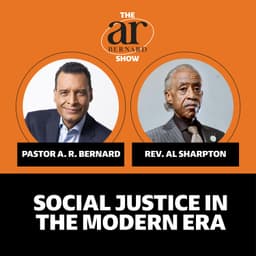
Reverend Al Sharpton has been at the forefront of social justice issues for half a century. At 13, he became the youth ambassador of Jesse Jackson’s Operation Breadbasket, and in 1991, he founded the National Action Network. Today, his influence continues to grow. He is the host of MSNBC’s PoliticsNation and the popular radio show Keeping it Real, and he has been both a critic and confidant of Presidents, including Barack Obama and Joe Biden.
In this episode, Sharpton and A.R. Bernard explore the future of the social justice and civil rights movements in America. They discuss what it has been like to outlive legendary leaders like Martin Luther King Jr., Malcolm X, and Medgar Evers. The two also address the challenges of bringing communities together in the face of violence and racial divides. This includes their shared experience at the funeral of Ajike "AJ" Shantrell Owens, a mother of four who was shot and killed in Florida. Additionally, they detail how they counsel each other, the baptism of NYC Mayor Eric Adams at Rikers Island, and the role of faith in memorializing those whose lives have been tragically cut short, including George Floyd.
Series AR Bernard Podcasts June 10, 2024 · 56 min · AR Bernard Podcasts
Reverend Al Sharpton has been at the forefront of social justice issues for half a century. At 13, he became the youth ambassador of Jesse Jackson’s Operation Breadbasket, and in 1991, he founded the National Action Network. Today, his influence continues to grow. He is the host of MSNBC’s PoliticsNation and the popular radio show Keeping it Real, and he has been both a critic and confidant of Presidents, including Barack Obama and Joe Biden. In this episode, Sharpton and A.R. Bernard explore the future of the social justice and civil rights movements in America. They discuss what it has been like to outlive legendary leaders like Martin Luther King Jr., Malcolm X, and Medgar Evers. The two also address the challenges of bringing communities together in the face of violence and racial divides. This includes their shared experience at the funeral of Ajike "AJ" Shantrell Owens, a mother of four who was shot and killed in Florida. Additionally, they detail how they counsel each other, the baptism of NYC Mayor Eric Adams at Rikers Island, and the role of faith in memorializing those whose lives have been tragically cut short, including George Floyd. ...more Show the full description Show less Reverend Al Sharpton has been at the forefront of social justice issues for half a century. At 13, he became the youth ambassador of Jesse Jackson’s Operation Breadbasket, and in 1991, he founded the National Action Network. Today, his influence continues to grow. He is the host of MSNBC’s PoliticsNation and the popular radio show Keeping it Real, and he has been both a critic and confidant of Presidents, including Barack Obama and Joe Biden.
In this episode, Sharpton and A.R. Bernard explore the future of the social justice and civil rights movements in America. They discuss what it has been like to outlive legendary leaders like Martin Luther King Jr., Malcolm X, and Medgar Evers. The two also address the challenges of bringing communities together in the face of violence and racial divides. This includes their shared experience at the funeral of Ajike "AJ" Shantrell Owens, a mother of four who was shot and killed in Florida. Additionally, they detail how they counsel each other, the baptism of NYC Mayor Eric Adams at Rikers Island, and the role of faith in memorializing those whose lives have been tragically cut short, including George Floyd.
Series AR Bernard Podcasts Support this leader Liking this video? Support this ministry.
Support this leader
Liking this video? Support this ministry.
Give
Support this leader Liking this video? Support this ministry.
609K followers
Rev. Bernard is a visionary whose teachings have lifted his church, the Christian Cultural Center (CCC), to become New York’s largest house of worship. With
609K followers
In this video 0:00 Mutual Admiration and Uncompromising Identity5:53 The Need for Authentic Mentorship and Accountability11:31 Growth, Change, and Building Institutions23:59 Spiritual Foundation for Social Change38:24 Building Bridges in a Polarized Nation
Mutual Admiration and Uncompromising Identity 0:00 Welcome to the AR Bernard Show. I'm your host, AR Bernard. It's great to have you here with us and, of course, truly an honor for me to host today's guest, the Reverend Al Sharpton.0:12 He's been at the forefront of social justice issues for half a century. He's taken action for causes he believes in for decades. And at age thirteen, he became the youth0:24 ambassador of Jesse Jackson's Operation Breadbasket. And in nineteen ninety one, he founded the National Action Network. Today, his influence is only0:36 growing. He's the host of MSNBC's MSNBC's Politics Nation and popular radio show, Keeping It Real. He has been both a critic and confidant of presidents,0:48 including Barack Obama and Joe Biden. Please welcome my friend and someone that I, interestingly enough, deeply admire, the reverend Al Sharpton.1:02 The rev. They'll pass.1:06 Thank you for accepting our invitation.1:08 Well, thank you for inviting me. And I I must say at the outset that, that you are somebody I deeply admire coming out of the Pentecostal Church roots1:20 and knowing your journey and what you've done and we may not agree on a particular political position at a time. But what you've done has been something that has reinforced me to where I've
1:32 come amazing ministers that I've seen in my lifetime.
1:41 Well, thank you, Rev. I appreciate that. And, I'll make sure the check is in the mail. But, seriously, we've been friends. We've had a relationship for three decades.
1:54 We understand each other's lane. And like you said, sometimes there are issues that we don't agree on, but we always find common ground and continue to be
2:06 faithful to our own communities because I think that's very, very important.
2:11 No. I think it's important. And, and one of the things I most admire about you is you have a reach way beyond our community, but you remain grounded and faithful
2:23 to our community. And that comes from who you are. It comes from your own self confidence your self esteem and I find that many of us that
2:35 are in the clergy are willing to give up some parts of ourselves if not all of ourselves for entree and the other circles and other areas and you've not compromised
2:47 who you are, you say we've known each other thirty years. You're the same AR Bernard in terms of who you are inside that you were thirty years ago thirty years ago, you'd say, okay. I'll support you on this rep, but I
2:59 disagree on this, but we don't have to be disagreeable. You're the same one thirty years later that tell the captains of industry and heads of government. I'm with you on this, but I don't agree with this and they still
3:10 embrace you and that I've not seen in my lifetime.
3:13 Well, I thank you for pointing that out. I I have a problem with some of my colleagues who... And let's be specific. You know, we're talking about white world and the
3:25 black world.
3:25 Right.
3:27 The white evangelical world and the black church world. And I've navigated effectively, I think, over the past forty years, in in both worlds without
3:39 losing my own roots and my own identity. And too often, we feel we have to compromise one in order to embrace the other. And I take some of my
3:50 colleagues to task who have entered into the space of especially white evangelicalism here in America and feel that they have to somehow divorce
4:02 themselves from their own community and relationship with leaders in that community like you. Because I take... I, you know, I take heat for for having a friend call the reverend Al Sharpton,
4:14 and that's because they don't know your story. They really don't know you. They know what the media, has painted in terms of its picture of you, but they don't know your journey. We'll get to talk about some
4:26 of that today. But that bothers me because in that particular world, there is a demand that we let go of our roots and our own communities, specifically the community
4:38 of color, in order to be accepted and participate in that world, that is predominantly white evangelical. I have some wonderful friends and relationships that are there,
4:50 still. We do a lot together. We work together. We see eye to eye on several things, but they know exactly where I'm coming from. And I think the difference is that they don't understand that we have a limited
5:02 number of leaders in the black community. Many have gone on. In fact, that opens the conversation because I I wanna quote and I
5:13 wanna do it accurately from Politico, an article that would came out on April twelfth on you. It says, Sharpton, once a velour track suited rabble rouser,
5:25 viewed with skepticism in elite circles, is now seen with the White House... Within the White House as the de facto leader of America's legacy civil rights
5:37 organization. Now I think it's important because they captured your journey in one paragraph, but there's so much within that journey
5:49 that people don't know about. You and I were talking before the, program started about the fact that, you know, there are very, very few civil rights leaders
The Need for Authentic Mentorship and Accountability
6:01 now. And with the issues that we're facing, we don't have much time to build new leadership. We have to appreciate and support and empower the leaders that we do have,
6:13 and you're one of those leaders.
6:14 Well, I think that, there's not only, very few civil rights leaders. You're absolutely have people that can get on social media or people that
6:26 can in the heat of an issue, you know, make noise but for consistently have a national structure and people that on staff that service people, there's few of these
6:38 left and even fewer that are grounded in the black church and my growing up in the church of God in Christ and then becoming Baptist and growing up in
6:50 Operation Breadbasket as you said under Reverend Jackson and Reverend Jones, I have a church orientation that I never left and never will that some of my colleagues, though
7:02 it may be few don't have so we have different lanes, but mine is church based. That's why I still do rallies every Saturday we sing gospel songs and there's some things I just won't do and
7:14 I think because of that I could communicate better with someone like you who again repeat is rare because I don't have a problem with you as a in a pastor
7:26 or say you know Reverend Al you need to look at it this way. I think you're wrong about that and most people that gives national promises who you telling they're wrong. But if you come out of a church, kind of
7:38 grooming, you wanna be corrected because that's what you supposed. You need a pastor. I don't have a a Bishop Washington alive anymore or Reverend Jones, so you need people that can say
7:49 from a place that you know is being truthful and honest, not from a place of they've got to serve somebody else's interest or they getting something out of it and I just think that you ought to look at
8:01 it this way because that's not who you are. You need somebody to bring you back to who you are. I remember not long ago during our convention that that political article was written
8:13 around. I got it one morning at the convention site hotel and got my iphone and you on doing one of your lectures and I was facing something I was gonna have a speaker that there's
8:25 something that I was a little concerned about and I was trying to figure out how it's gonna have the staff smooth it over and you sat down on the pulpit at CCC and says the world doesn't know you nothing and I said, Oh,
8:37 he did that service for me and and you know that wasn't that long ago, but it was we're talking like a week after my convention, and it snapped me up. So sometimes you can correct people
8:49 without even knowing you correct them.
8:50 That is so true. That is so true. Yeah. And getting our people to understand that the world owes you nothing, but offers you so many opportunities to do something, to to, experience
9:02 things, especially in a generation that is leaning heavily in the direction of feeling entitled. No. The world doesn't know anything. But I'm glad that there is because someone
9:14 will will ask, you know, who does the rev... Who reverends the rev? The way my producers put it. Yeah, we all need a pastor, we all need someone
9:26 that we could look to and hold us accountable, be part of the moral compass in our lives. And with you and I, as we continue to mature, not age,
9:37 to mature, our mentors and our pastors, they have gone on and we are now in those senior positions and it becomes more
9:49 of a peer level relationship that we have to find someone authentic that we can submit to and be transparent and vulnerable with. Because you can't... You can be transparent with people,
10:01 which means to tell them what your life is about, but you can't always be vulnerable with everyone, which means to allow them to speak into what your life is about.
10:10 And the and the people that you do become vulnerable to have to be people that you can trust are not trying to manipulate your vulnerabilities, but they're really trying to help you with it.
10:22 Because like I grew up as I said, looking up to certain people who have named and then one day it just hits you. You've got younger guys and ladies looking to me and like I
10:34 see go speak places and someone might have a book of mine. Someone tells me something that they saw I did on TV so I had to go to somebody like you that is totally at a at a
10:46 higher level than any minister I know in the country right now, black or white and say well, how do I handle this and you don't necessarily wanna be vulnerable to everybody unless you're
10:58 convinced they're not gonna manipulate your vulnerability. They're not threatened by you or intimidated by you. They're gonna tell you the truth and you need that. Because without that, you gotta guess on your own, and
11:08 you may guess wrong.
11:09 Yeah. Yeah. No. That's true. And people don't know that you have these kinds of relationships in your life where you're open to hear what someone that you trust
11:21 has to say about any given situation or circumstance. I remember, when you you called me, it was around the Sean Bell shooting, And you were preparing to
Growth, Change, and Building Institutions
11:33 do a march down Fifth Avenue, and you asked if I would consider being involved. And I said I would love to. It would be... It was something new for me in terms of my congregation
11:45 and my participation in such a public demonstration of, protest against how things were handled by our our policing system here. But
11:57 I said to you, I said, well, as long as no one exploits this situation to push their agenda, that we stay united
12:09 around the purpose. Right. And you said to me, you said, I'm gonna guarantee that that doesn't happen. And, all of a sudden, yeah, the elected official join in because, you know,
12:20 everyone was hesitant. They weren't sure about it.
12:22 Well, we were talking about marching out Fifth Avenue, like, what, two weeks before Christmas.
12:26 That's right.
12:28 When you said you were going and you brought hundreds of your members, everybody then it was acceptable, and and you, reminded me that you said there's gonna be no hijacking of this
12:40 and no violence. And I think Harry Belafonte even joined.
12:43 That's right. That's right. That's right. And people don't know the back stories behind these things and how we find common ground and work together because, I sat with with with Mike Bloomberg,
12:55 who was mayor at the time, and he asked me about the situation. And I said to him, I said, mayor, there are people and organizations who want to exploit this thing because it was a powder
13:06 keg waiting to explode in our city. You know? People were ready to protest. And I said to him, I said, mayor, you're going to have to make a carefully, crafted visceral
13:18 response to this and let your police commissioner take the heat. And right after that conversation, we did a press conference at city hall, and,
13:31 Mike Bloomberg said, he said, you know, it seems to me that it was excessive force, but we're going to allow the investigation to continue and see how it comes out. Now
13:43 he took a beating from the media for a week after he made that statement.
13:49 He did.
13:49 And then when things were calm, there were no explosions, no protests, no violence. All of a sudden, the media switched and said it was the best thing that he could do. So people
14:01 don't know the backstory behind these things that happened.
14:04 No. And and I remember, few years later when Eric Garner happened and the Blasio was mayor and we convene faith leaders and you got the
14:16 cardinal to help put together a group of faith leaders that still meet on a monthly basis at the Cardinals residence and and I teased you saying I never thought I'd be
14:28 sitting around the father's room, but you insisted that those of us that had weight should be at the table even if we don't agree and I remember just maybe three
14:39 four weeks ago. Uh-uh I was convening some of the Haitian leaders and you said you would support it. You wanted to bring people in and you call me back and say I'm gonna bring Rabbi Potas
14:51 and I said really and he came and he made probably the most passionate speech at that rally at. So your reach always weighed carefully to your beliefs, but your reach, I don't
15:03 think people really understand
15:06 I like it like that. Okay. I like to move as I can in the background. Some of my colleagues, they they they like the glory. They like the spotlight. They wanna be a celebrity, and that's a dangerous
15:18 thing because I pastor. I shepherd quite a few high profile celebrities, and their lives are not... As you know for yourself, their
15:29 lives are not what they appear to be, especially on camera.
15:32 Right.
15:33 You know, it can be quite challenging to navigate that that space and too many of our colleagues then, that's what they wanna be. Right. I wanna affect change, lasting change, and make an impact.
15:46 So that's that's that's that's what drives me, you know, and it's about building bridges and building relationships. Let's let's take a look at that journey, the velour tracksuit guy.
15:58 You've come a long way. And I... And I'll say this, this is this is a public, podcast that we've seen across the country and around the world, that I'm proud of
16:10 your growth and development and your willingness to change. That's important because you'll never grow unless you're willing to change.
16:19 No. I think I think that you've gotta be willing to grow and willing to change. And if you really believe in God you do not take for granted. God opens doors for you and
16:31 you become so locked into the image your circle may have your your surrounding fan club that you don't say that
16:43 No II think I need to do this differently. I need to emerge and some of them may leave you because they want you to be stuck because they're stuck right and those that are not stuck will grow with you or
16:54 grow somewhere else on their own and you've gotta be willing to do that because times change. I mean uh-uh reading the Bible as you and I both of men of the word, David was not
17:06 throwing slingshots when he was king. I mean there's a difference between David and shepherd boy with his daddy's sheep and David the Warrior with Goliath and David the king and if you can't make that growth, you can
17:18 never be king and I think the problem is we have too many shepherd boys that wanna be king but wanna bring the slingshot and the smooth stones into the palace.
17:27 The first time I preached that sermon you just gave me, I'm gonna give you credit for it. After that, God spoke to me. You know how it goes in
17:36 our service. Yeah. I know how it goes.
17:37 But but you're absolutely right. We live life on levels. We arrive in stages. We experience it in seasons. And as we move from one level to another, everyone around us is not growing, with
17:49 us. And the... It's not necessarily that we cut those relationships. Sometimes we have to. Right. That's the extreme. But often we have to reposition those individuals or try to retrain those individuals,
18:02 because they're not growing with us, and they become out of place or not mature enough to handle what comes with each level and stage of life. You've navigated that
18:14 well. I've watched you, you know, we we we call, Reverend Sharpton version one point o, two point o, three point o, you know, that's how the world classifies us as as as we change. But there has to
18:26 be that understanding for the need for change and to broaden your reach, your network, and and understand what's expected at these new levels and
18:37 everyone can go there with you. But you have to be willing to make those hard decisions to let people go. I've seen elected officials not understand that and try to take people with
18:49 them who could only occupy that space when they were a community organizer. But now they become an elected official. It's changed, and they can't have
19:01 those same influences and relationships around them, but they're not willing to let them go.
19:05 And you've gotta accept that, sometimes, people... And you may fall out for for whatever reason. And that sometimes God uses that to
19:17 dismiss people from where your rise or your growth is because they can't grow with you. So what you say, how could they not understand what I'm doing? Maybe God is
19:29 severing that so because he knows they're not ready to take the next step of the journey.
19:34 Yeah.
19:34 I think the thing that I always think about is what really got to me which made me even seek having counseling with, with you, really. I I started to say someone like
19:46 you, but I have very few people I see counsel from. And as I was on a trip, many... Maybe twelve years ago landed in Newark Airport and it was
19:58 about midnight and I'm rushing through with whoever's traveling with me to go to the car and get home so I can get up and do what I'm gonna do the next morning and I saw an elderly lady. She may have been in the
20:10 70s 80s walking through the airport. She had a young guy with her and she said Reverend Sharpton and I'm rushing. I wait, she said. No. I wanna talk to you a minute, I said. I stopped and
20:22 she said, will you shake my grandson's hand? I said, yeah and the guy with me was saying we gotta move. I said no, I shook his hand, she says. You know my grandson will not know Martin Luther
20:33 King may not know Jesse Jackson, but he'll know you so I was flattered, she says. Look me dead in my eyes, she says. I hope you won't let him down and out of all the advice I had at
20:45 that time it really got to me and I thought about that for years, which is one of the reason I saw the relation with you is because of a temporary popular
20:57 stand or because you're gonna make a headline to get a certain amount of things am I gonna let that kid down because at the end of the day, that's what matters. Did you really make a difference or did you
21:09 just make yourself... I mean, how popular do you need to be? How many times do you need to see yourself on TV? Or are you letting people down?
21:18 Legacy. What we leave behind, the impact that we have, and how long does it continue to impact people? You and I, for the last about a year
21:30 now, have been having these conversations. Right. What does the future of the civil rights movement look like in America? Who will lead that future?
21:42 How can we impact that future today? What are your thoughts on that?
21:47 I I think that one of the things that we must learn in, in my generation and the generations to come is that we have to build institutions
21:59 that can keep civil rights and social justice. When I look at other communities and and the thing I think that we never really wanna admit, everybody had to struggle. They may not have had our struggle,
22:11 but if you look at the Jewish community and the Latino community and other communities, they had to struggle and they build institutions. And what I wanted to say is that,
22:23 to you, in our meetings is that I don't want to have built National Action Network as an organization, and it died with me because a lot of our ministers with their churches
22:35 Mhmm.
22:36 And civil rights leaders with the organizations are fine with is over when I'm over and all of this for what and I think that we've gotta build institutions. That means
22:48 those that succeed you one they need to succeed you. They shouldn't be just uh-uh players on a board that you manipulate, let them do it and they have to find what to
23:00 do in their time. Like I had to find what to do in my time when when I was growing up, Pastor Bernard one of the things I learned early in civil rights as a teenager is that most of the
23:12 guys mentoring me were from the deep south and had certain cultural leanings that way I was from Brooklyn, New York so the we shall overcome kind
23:23 of meek persona didn't work in Brooklyn. So the reason I was more edgy is I came from an edgy community. There was a difference Doctor King came from a middle class
23:35 background in Atlanta. Jesse, Greenville, South Carolina segregation, then to Chicago. Brooklyn was hardcore, and most of the people that I went to school
23:47 with were not in love with doctor King's philosophy. They were more Malcolm. That's right. How do you balance that and still be true to who you are and whoever and whatever group succeedsShow more
Comments No comments yet. Start the conversation.










Comments
Keep it kind. Comments are public.