Faith & Wisdom
New York Times Article: Finding God in the App Store
Lauren Jackson explores the booming "faith tech" industry where tens of millions are using AI chatbots for spiritual guidance. The article examines apps like Bible Chat (30M+ downloads), Hallow, and PRAY.COM (25M downloads) that offer 24/7 digital chaplaincy services, raising questions about technology's role in religious practice.
By PRAY.COM Editorial Team · Published · Updated · 6 min read
Share this
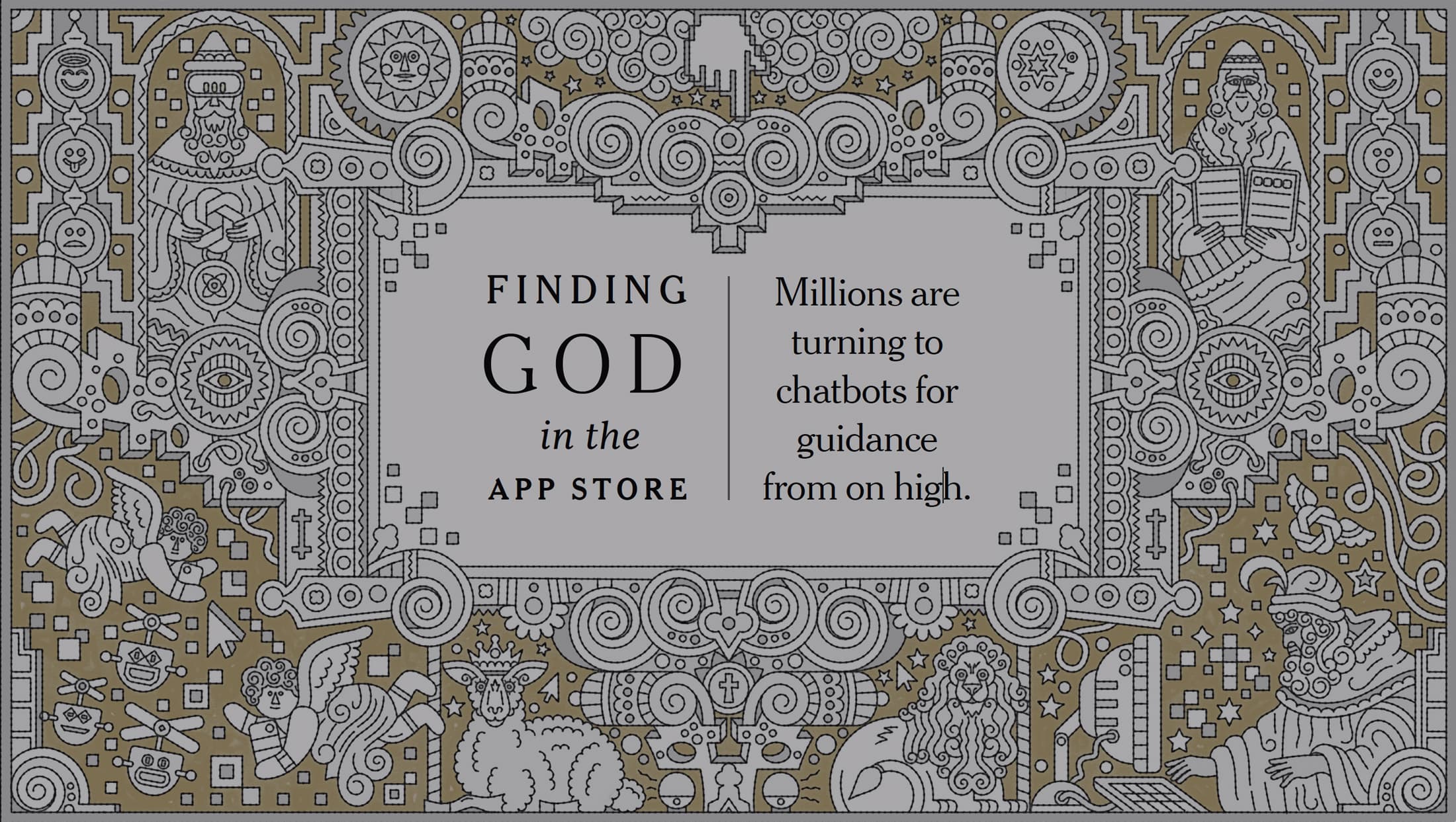
Key Takeaways
• Industry Growth: Faith tech apps are reaching top App Store rankings, with users paying up to $70/year for subscriptions
• Digital Chaplaincy: Chatbots trained on religious texts offer "on-call" spiritual guidance for confessions, prayers, and life questions
• Accessibility Solution: Apps address barriers to traditional worship, serving those who've never attended religious services
• Mixed Reactions: Religious leaders cautiously support the technology as supplement to, not replacement for, human community
• PRAY.COM Perspective: Ryan Beck (CTO) emphasizes chatbots' affirming nature, helping make worship accessible to underserved populations
• Theological Concerns: Experts worry about chatbots' tendency to validate users rather than provide spiritual discernment
Complete Article
Finding God in the App Store By Lauren Jackson Sept. 14, 2025, 5:00 a.m. ET
God works in mysterious ways — including through chatbots. At least, that's what many people seem to think.
On religious apps, tens of millions of people are confessing to spiritual chatbots their secrets: their petty vanities and deepest worries, gluttonous urges and darkest impulses. Trained on religious texts, the bots are like on-call priests, imams or rabbis, offering comfort and direction at any time. On some platforms, they even purport to channel God.
The "faith tech" industry is booming, powered by chatbots on religious apps that are rocketing to the top of Apple's App Store. Bible Chat, a Christian app, has more than 30 million downloads. Hallow, a Catholic app, beat Netflix, Instagram and TikTok for the No. 1 spot in the store at one point last year. In China, people are using DeepSeek to try to decode their fortunes. The apps are attracting tens of millions of dollars in investments, and people are paying up to $70 a year for subscriptions. Now, apps like Pray.com — which has about 25 million downloads — are rolling out chatbots, too.
App founders said they considered the technology to be a digital chaplaincy, a tool that is helping millions of people, both inside and outside of faith, express themselves spiritually. Several religious leaders said they so far supported people using the chatbots, as long as they complement, but do not replace, the work of faith communities.
"There is a whole generation of people who have never been to a church or synagogue," said Rabbi Jonathan Romain, a leader within Britain's Reform Jewish movement. "Spiritual apps are their way into faith."
Others aren't so sure. "The curmudgeon in me says there is something good about really, really wrestling through an idea, or wrestling through a problem, by telling it to someone," said Fr. Mike Schmitz, a Catholic priest and podcaster. "I don't know if that can be replaced." He is also worried about data privacy. "I wonder if there isn't a larger danger in pouring your heart out to a chatbot," he said. "Is it at some point going to become accessible to other people?"
Still, people are bringing their headiest concerns to chatbots. Heidi Campbell, a professor at Texas A&M who studies technology and religion, said the first time she saw a spiritual chatbot was a few years ago, on the gaming platform Twitch, which hosts a chatbot called A.I. Jesus. She watched gamers ask questions like, "Hey Jesus, what's your favorite football team?" Others became more personal, asking about death, the nature of time, their depression.
With the rise of ChatGPT, these chatbots are now a growing business. In a way, they're addressing an access problem. For millenniums, people have longed for spiritual guidance, and have had to travel, sometimes great distances, to reach spiritual leaders. Chatbots are at a user's fingertips, always.
"You don't want to disturb your pastor at three in the morning," said Krista Rogers, 61, of Xenia, Ohio. She said she loved the YouVersion Bible app, but said she also often turned to ChatGPT with spiritual questions.
Smaller apps and websites have trained chatbots to respond as if they were a god, an approach some app founders and users online criticize as sacrilegious. The website ChatwithGod lets users select their religion and what they are looking for, including comfort, confession or inspiration, and provides tailored responses. "The most common question we get, by a lot, is: Is this actually God I am talking to?" said Patrick Lashinsky, ChatwithGod's chief executive. He provided The New York Times with dozens of questions and conversations from anonymous users on the platform.
ChatwithGod's approach is an exception. The most popular apps function simply as a spiritual assistant, directing people to doctrine and scripture that can answer their questions.
"People come to us with all different types of challenges: mental health issues, wellbeing, emotional problems, work problems, money problems," said Laurentiu Balasa, the co-founder of Bible Chat.
Delphine Collins, a 43-year-old preschool teacher in Detroit, turns to chatbots when she feels overwhelmed. "In my neighborhood when things are not right or when I hear sad things on the news, I go on the Bible Chat app," she said.
After a woman in her community was stabbed to death while working at a McDonald's, Ms. Collins asked the chatbot for a "prayer for healing."
It offered a psalm and replied: "As you seek healing, let us turn to the Word of God, which is a source of comfort and strength. The Scriptures remind us of God's power to heal and restore." She said it helped.
The chatbots are meeting a need, but they raise deep theological questions.
They present a radical shift from how many religious traditions think about guilt and accountability. The companies train the chatbots on religious texts and consult with theologians about their guardrails. Still, the chatbots are based on foundation models, like ChatGPT and Gemini, that are designed to validate users.
"They're generally affirming. They are generally 'yes men,'" said Ryan Beck, the chief technology officer at Pray.com. He doesn't see that as a problem. Mr. Beck was once imprisoned after being involved with gangs and illegal drugs in Los Angeles. After he found faith, he made it his mission to make worship accessible to others. "Who doesn't need a little affirmation in their life?"
Chatbots are not seminarians, but their approach is shaping how people think about ancient religious questions, on sin, confession and death.
Karen Fugelo, who works at a middle school in Pennsylvania, said she opened her religious apps every day before getting out of bed. Recently, she has been concerned about her mother, who is elderly and "reaching the end of her life's journey," Ms. Fugelo said over email. On Hallow, she asks the chatbot questions about "how to prepare myself as well as my mother for going to be with God."
This is tricky theological territory because chatbots "tell us what we want to hear," said Ms. Campbell, the technology and religion professor. "It's not using spiritual discernment, it is using data and patterns."
But the chatbots' affirming nature may be the reason many people like them. Ms. Collins said she had found more support on the Bible Chat app than she had at her church. She said she faced judgment when she once shared her health struggles with her congregation. "People stopped talking to me," she said. "It was horrible."
Founders say their apps are intended to only supplement in-person worship and community. "It shouldn't be something where it replaces human connection. It does not have a soul from the church's perspective," said Alex Jones, the founder of Hallow.
He hopes the app will inspire people to seek out religious communities. Many apps, including Hallow, explicitly help people find local congregations to attend.
In the United States, where around 40 million people have left churches in the past few decades, the apps may lower the barrier to re-enter spiritual life. They allow people to express their existential and theological curiosities without the discomfort or shame of an in-person meeting.
"They aren't going to church like they used to," Mr. Beck said. "But it's not that they're less inclined to find spiritual nourishment. It's just that they do it through different modes."
Chat conversations, provided by ChatwithGod.ai, are excerpts from discussions between the company's chatbot and users.
Read by Lauren Jackson. Produced by Tina Zhou and Rumsey Taylor. Audio produced by Tally Abecassis.
Lauren Jackson is an associate editor and writer for The Morning, The Times's flagship daily newsletter.
Topics
Keep reading
- Our Favorite BooksWe hope you’re having a great summer! This time of year is an excellent time for reading, so we’re sharing some of our favorite books.Faith & Wisdom · 5 min read
- Our Favorite Books - Summer Reading EditionThis collection includes best-sellers from some of the top Christian thinkers and leaders, and they offer fresh perspectives on faith, discipleship, and the love of Christ. We’re excited for you to start your next book!Faith & Wisdom · 2 min read
- Why Pastor Appreciation Month MattersHonor your pastors Obey them that have the rule over you, and submit yourselves: for they watch for your souls, as they that must give account, that they may do it with joy, and…Faith & Wisdom · 4 min read
- HeyGen Case Study: PRAY.COM's AI Translation Revolution - Breaking Global Language Barriers in MinistryThis case study features Ryan Beck, co-founder and CTO of PRAY.COM, discussing how AI translation technology is transforming global ministry outreach. Beck explains how PRAY.COM partners with HeyGen to enable ministry leaders to communicate directly with international communities in their native languages, creating unprecedented connections between organizational founders and the people they serve worldwide. The conversation highlights the transition from audio-only to video translation capabilities and the profound impact on global humanitarian efforts.Interviews · 5 min read
- Building a Successful Faith-Based App: PRAY.COM's Business Strategies with Ryan BeckIn this insightful episode of the SubClub podcast, hosts David Barnard and Jacob Heiding interview Ryan Beck, co-founder and CTO of PRAY.COM. Ryan shares the business journey behind building the world's leading prayer and faith-based audio content app. The conversation explores PRAY.COM's evolution from a social network for faith organizations to a consumer subscription platform, highlighting effective monetization strategies, customer acquisition tactics, and product development approaches. Ryan provides valuable insights into reaching older demographics through various marketing channels, the importance of diversifying revenue streams beyond just subscriptions, and why the team maintains "revenue" as their ultimate north star metric. Throughout the interview, Ryan emphasizes the data-driven yet mission-focused approach that has enabled PRAY.COM to successfully navigate the unique challenges of building a technology platform in the faith space.Interviews · 3 min read
- From Prison to Providence: Ryan Beck's Journey to Co-Founding PRAY.COMIn this powerful episode of the Kingdom Driven Entrepreneur podcast, host Shae Bynes interviews Ryan Beck, co-founder and Chief Technology Officer of PRAY.COM. Ryan shares his remarkable journey from teenage drug dealer to faith-driven tech entrepreneur, revealing how a profound encounter with God during his time in jail completely transformed his life. After being released, Ryan pursued theological studies before discovering his passion for computer science, which eventually led him to co-found PRAY.COM in 2016. Throughout the conversation, Ryan discusses how he approaches leadership as a servant, empowering his team members rather than wielding power over them. He also explores how he balances ambition with relationship, seeking excellence in all areas of life while cultivating a Kingdom culture within a Silicon Valley tech startup. The interview highlights how God's providence guides our steps, revealing how a seemingly chance encounter between old high school acquaintances led to the creation of what is now the world's number one app for daily prayer and faith-based audio content.Interviews · 3 min read
- From Unplanned Pregnancy to Digital Ministry: The Providential Story Behind PRAY.COMIn this heartfelt interview with award-winning Christian artist Matthew West on The Matthew West Podcast, PRAY.COM co-founder Matt Potter shares the remarkable story behind one of the world's leading prayer and faith-based content platforms. Potter's journey begins with his own miraculous entry into the world when a pregnant 15-year-old girl, on her way to an abortion clinic, stopped at a church instead—a decision that would save his life. From his adoption by a Christian couple to meeting Steve Jobs at Pixar as a teen, Potter's path ultimately led him to build a successful tech company before feeling spiritually empty despite worldly success. Through a divinely orchestrated encounter with future co-founder Steve Gatena, who had experienced his own spiritual awakening following a tragic loss, PRAY.COM was born. Now, eight years later, the platform has accumulated an astounding 2.5 billion listening minutes and reached millions with the gospel message. Throughout the conversation, Potter reveals the profound difference between worldly success and spiritual fulfillment, offering powerful examples of lives transformed through prayer and highlighting the platform's innovative features, including clinically proven meditative prayer content that positively impacts mental and physical health.Interviews · 3 min read
- INTERVIEW: How Personal Trauma Led to Creating PRAY.COM - The Story Behind the World's Leading Prayer and Meditation AppThis in-depth conversation with Matt Potter, co-founder of PRAY.COM, reveals the extraordinary human stories and pivotal life moments that created what is now the leading prayer and meditation application worldwide.Interviews · 10 min read
- Leading Organizations That Matter: Is Faith in Fashion? Interview with PRAY.COM's Matthew PotterIn this episode of "Leading Organizations That Matter," host Ray Spadoni explores the intersection of faith, business, and technology with Matthew Potter, co-founder of Pray.com. The conversation examines whether faith is becoming culturally acceptable again, how mental health concerns are driving people toward spiritual resources, and how businesses are increasingly embracing employees' whole selves, including their faith lives. Matthew shares his remarkable personal story, the growth of Pray.com as a platform, and how they're measuring the impact of prayer on mental health through scientific research.Interviews · 3 min read
- PRAY.COM Founder Steve Gatena Honored with LA Times Executive Leadership AwardIn a landmark moment for faith-based technology and leadership, PRAY.COM Founder and CEO Steve Gatena has been awarded the prestigious LA Times Executive Leadership Award in the Small Business Founder category. This rare and meaningful recognition highlights Gatena’s significant contributions to the Southern California business community and underscores the growing influence of Christian tech leaders in the digital age.Interviews · 3 min read