Faith & Wisdom
David And Goliath: Bible Story and Meaning
Discover the biblical story of the battle of David and Goliath
By PRAY.COM Editorial Team · Published · Updated · 6 min read
Share this
Key takeaways
- The story of David and Goliath appeared in the Book of Samuel, a book in the Hebrew Bible, and two books in the Old Testament.
- As modern-day Christians, what can we learn from the ancient story of David vs.
- David didn’t need to be of equivalent height or have heavy armor and a javelin to defeat Goliath.
- Goliath stood in stark defiance of God’s plan.
- We all face challenges that appear truly giant, such as seemingly insurmountable problems at work, in personal relationships, or in your own mind about what you can do and achieve in this life.

The classic tale has been told repeatedly throughout history to express the virtues of a plucky underdog facing a larger, more intimidating foe.
For all its interpretations across theatre, TV, film, and music, it’s worth revisiting the original story as told in the book of Samuel to best absorb the true theological meaning and moral takeaways.
We’re going to cover the story in its original text, analyzing its principal themes and extracting the lessons that will serve to enhance our relationship with God and the world at large.
The Bible story of David and Goliath
The story of David and Goliath appeared in the Book of Samuel, a book in the Hebrew Bible, and two books in the Old Testament.
In the biblical account of 1 Samuel 17, Saul (the king of Israel) and the Israelites face the Philistines in single combat in the Valley of Elah.
Twice a day for 40 days, the Philistines send Goliath, their champion giant who’s described as “four cubits and a span,” translating to approximately 6’9” in height. He dons a set of armor and wields a javelin as his weapon.
Saul is afraid of facing Goliath, owing to his immense stature. David, however, a young man and shepherd, accepts the challenge willingly. He refuses to accept the offer of Saul’s armor, though, instead opting to take only his staff, sling, and five smooth stones from a nearby brook.
Facing Goliath, David proclaims, "This day the Lord will deliver you into my hand, and I will strike you down, and I will give the dead bodies of the host of the Philistines this day to the birds of the air and to the wild beasts of the earth; that all the earth may know that there is a God in Israel and that all this assembly may know that God saves not with sword and spear; for the battle is God's, and he will give you into our hand."
He continues to launch a stone from his sling directly into the center of Goliath’s head, downing him with a single shot. Upon falling, David cuts off Goliath’s head using the giant’s sword, and the Philistine army flees at the sight. He brings the head away from the battle lines and back to Jerusalem.
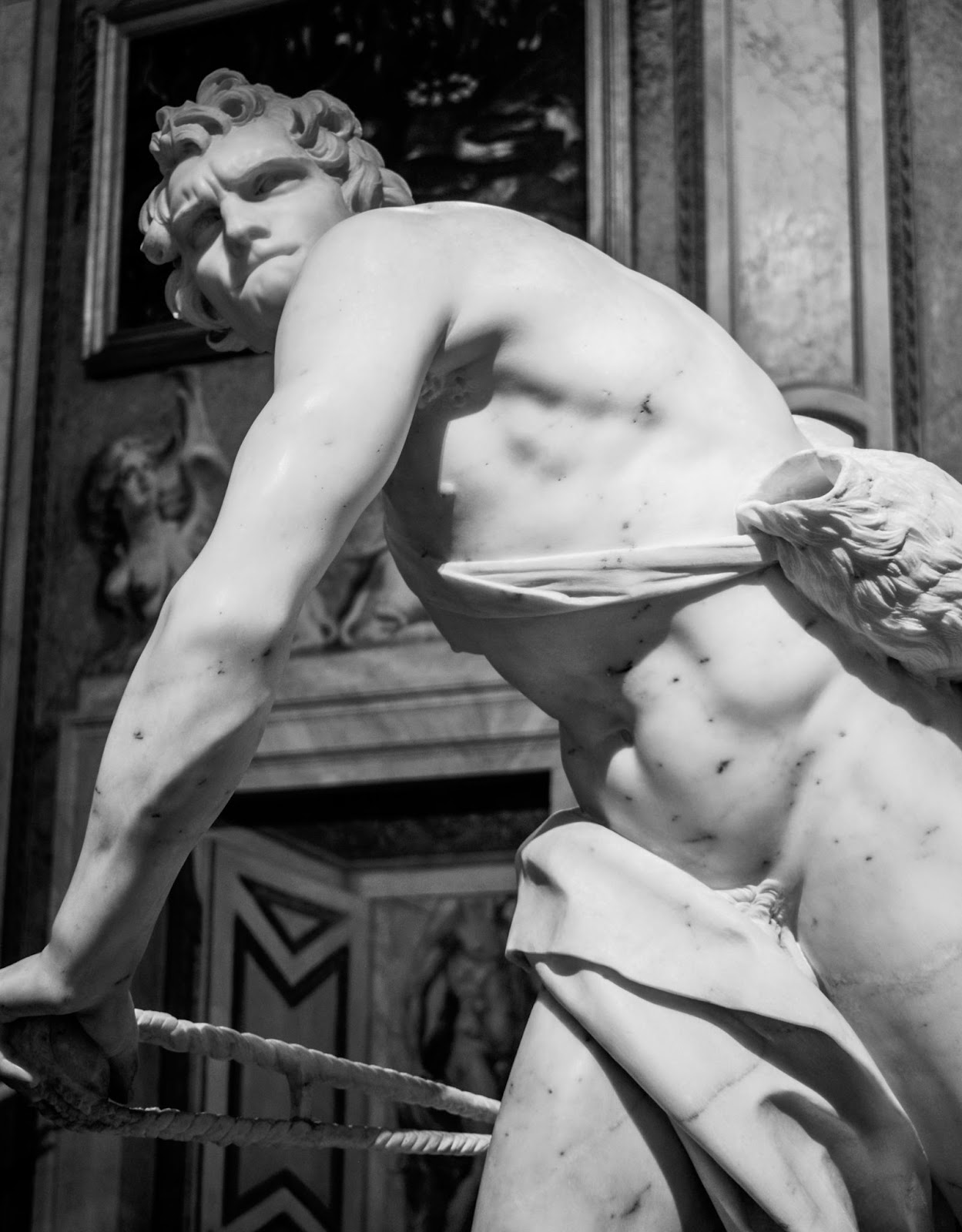
Meaning and interpretations of David and Goliath
There are many historical, philosophical, and religious implications of this story.
The most apparent purpose is to exemplify why Saul wasn’t fit to lead Israel as a king. Samuel 9:2 describes king Saul as “a head taller than anyone else in all Israel,” making him the most obvious choice to defeat the mighty Goliath. However, his cowardice (and, perhaps more importantly, David’s bravery) led him to relinquish the responsibility.
This leads us to the philosophical interpretation, which centers around the power of bravery in the face of grave uncertainty. By all physical measures — the lack of any armor, the lack of an equivalent weapon, and a massive discrepancy in height and stature — David shouldn’t have felt so confident in facing the larger foe.
But, without any fear or concern, he did so and succeeded. Why did David feel so assured?
The one thing David had that the giant and all the Philistines didn’t was an unshakeable faith in God.
Goliath “defied the armies of Israel” (1 Samuel 17:10) and “the armies of the living God” (1 Samuel 17:26), and David sought to strike him down “in the name of the Lord Almighty” (1 Samuel 17:45).
Key lessons from David and Goliath
As modern-day Christians, what can we learn from the ancient story of David vs. Goliath?
There are three key lessons to consider.
1. With God by your side, anything is possible
David didn’t need to be of equivalent height or have heavy armor and a javelin to defeat Goliath. It was the accessory of faith in the Lord God that swayed the battle in David’s favor more than any weapon ever could.
So, when we go about our daily lives and confront challenges that seem too huge to face, consider this — you aren’t facing your battle alone. When you live according to Christian principles and speak with God through prayer, He is by your side. With that, you can achieve more than you or anyone thought possible.

2. Defying God’s plan is folly
Goliath stood in stark defiance of God’s plan. He insulted the Israelites and their religious faith in God. This set the stage for his downfall.
God is omnipotent — there is no power greater than His. When you defy His will, you are setting yourself up to fail.
3. Intelligence over brawn
There’s a less ideological lesson to take away from the Goliath story. That is the superiority of intelligence over brawn.
David wasn’t concerned about the size difference between himself and Goliath. In fact, the giant’s increased size made him an easier target for David’s slingshot. Preparedness and novel weaponry, a result of intelligence, helped him succeed.
The story of David
We all face challenges that appear truly giant, such as seemingly insurmountable problems at work, in personal relationships, or in your own mind about what you can do and achieve in this life.
So, from where can we summon the courage needed to face these challenges boldly and without concern?
Look to David and see that intelligence, faith in yourself, and faith in God can provide all the courage and support you will ever need.
To always stay connected to God’s word and the power of the Holy Spirit, download the Pray.com app in the iOS App Store or on Google Play.
Keep reading
- New York Times Article: Finding God in the App StoreLauren Jackson explores the booming "faith tech" industry where tens of millions are using AI chatbots for spiritual guidance. The article examines apps like Bible Chat (30M+ downloads), Hallow, and PRAY.COM (25M downloads) that offer 24/7 digital chaplaincy services, raising questions about technology's role in religious practice.Faith & Wisdom · 6 min read
- You Have Not Because You Ask Not: Bible Verse ExplainedLearn about the meaning of James 4:1-3 with Pray.comFaith & Wisdom · 8 min read
- Meaning Of Rainbow In The Bible: Interpreting The Symbol Of HopeWhile we often associate rainbows with children's toys, their hopeful message dates back to the Book of Genesis. In this article, we want to help you understand that history better.Faith & Wisdom · 12 min read
- 10 Powerful Father's Day Prayers and BlessingsThe Power of Praying For the Dads in Your Life "A good father is one of the most unsung, unpraised, unnoticed, and yet one of the most valuable assets in our society." - Billy…Faith & Wisdom · 5 min read
- 10 Heartfelt Prayers for Friends: A Guide to Strengthening Bonds through FaithThe Power of Prayers in Friendship Friendship is a beautiful gift that enriches our lives with joy, support, and shared moments.Faith & Wisdom · 3 min read
- When Does Lent Start and End?The word Lent comes from an old English word, “lencten”, which means “spring season”. It is a time of religious observance, covering the 40 days from Ash Wednesday to Holy Thursday (Maundy Thursday).Faith & Wisdom · 6 min read
- The Beauty of Easter: A Journey of Resurrection, Redemption, and CelebrationEaster stands as a radiant celebration, echoing with profound significance in the hearts of Christians worldwide. In this article, we will thoughtfully explore the biblical origins, cherished traditions, and the immeasurable joy that Easter brings to believers.Faith & Wisdom · 3 min read
- What's Ash Wednesday? It’s Meaning and History ExplainedApart from Christmas and Easter, Ash Wednesday is one of the most attended Masses of the year for the Catholic Church.Faith & Wisdom · 6 min read
- What Happened at the Cross of Jesus?One of the most captivating stories in the Bible is the life and death of Jesus Christ. You could argue the crucifixion of Jesus is the most tragic story of them all.Faith & Wisdom · 6 min read
- Palm Sunday: Meaning, Story In The Bible, and Its Importance For ChristiansExplore the Biblical events that brought Jesus to Jerusalem as a Savior & King.Faith & Wisdom · 13 min read